Growing peppers & chillies in Zimbabwe: the complete guide
Pepper farming in Zimbabwe from seedbed to harvest — types, soil pH, spacing, feeding, watering and grading for sweet peppers, hot chillies and paprika, with chilli farming Zimbabwe figures sourced throughout.
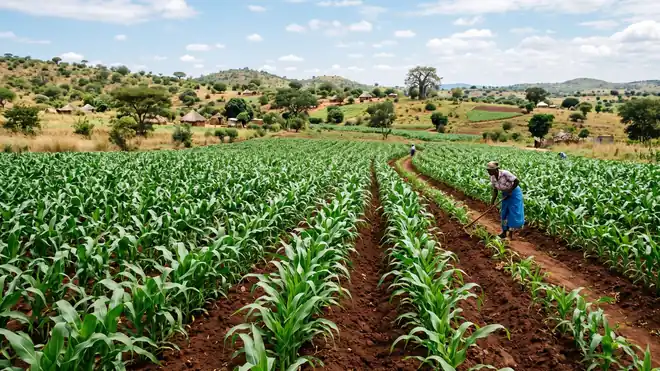
Pepper farming in Zimbabwe covers more ground than most growers realise — sweet bell peppers for the fresh market, fiery Bird’s Eye and other hot chillies, and paprika, one of the country’s longest-standing contract export crops. All three are the same botanical family with roughly the same agronomy, so one guide can cover all of them: soil to harvest, every figure sourced, for chilli farming Zimbabwe growers at any scale.
New to the crop, or scaling up? This is the pillar guide covering sweet peppers, hot chillies and paprika together. For disease and pest control, see pepper & chilli pests and diseases — the organic way; for the export market, see Zimbabwe’s chilli export boom.
At a glance
| Stage | Target | Source |
|---|---|---|
| Soil pH | 6.0–6.5 | Seed Co |
| Deep ripping depth | 40–45 cm | Seed Co |
| Seedling readiness | 15–18 cm tall, 5–6 true leaves, ~60 days from sowing | Seed Co |
| Open-field spacing | 50 cm × 50 cm on a raised bed (~26,600 plants/ha) | Seed Co |
| Irrigation requirement | 600–700 mm for the cycle | Seed Co |
| Transplant to first harvest | 80–90 days (warm), 110–120 days (cool) | Seed Co |
| Bell/sweet fruit weight at harvest | 150–180 g | Seed Co |
| Yield potential, unpruned F1, open field | 80–90 t/ha from ~25,000 plants | Seed Co |
Know your crop: sweet, hot, and paprika
Peppers and chillies are all Capsicum — the difference between a bell pepper on your plate and a paprika pod destined for export is mostly variety and end use, not a different set of growing rules.
- Sweet/bell peppers are large, blocky, three- or four-lobed fruits with thick walls, dark green when immature and turning red, orange, yellow or even black as they ripen (Seed Co). F1 hybrids carry combined disease resistance and out-yield open-pollinated types, at a higher seed cost (Seed Co).
- Hot chillies — Bird’s Eye and similar types — sell fresh, dried and processed, and are the sector’s fastest-growing export opportunity. Smallholders at Nyakomba Irrigation Scheme in Nyanga have long exported Tabasco-type chillies to the US: 187 farmers exported 60 tonnes in one recorded season, each working plots of roughly 0.2 ha (The Zimbabwean).
- Paprika is Zimbabwe’s long-standing contract crop, grown for oleoresin extraction and whole-pod export since the 1990s, historically under cooperative contracts at irrigation schemes (SNV).
One rule applies to all three: never plant into ground that previously carried tomato, eggplant or another pepper crop — they share the same pest and disease problems, and rotation breaks that carry-over (Seed Co).
Climate, site and soil
Peppers germinate best at 24–28°C by day, 20–21°C by night, with a hard minimum of 13°C below which seed won’t germinate at all (Seed Co). Flowering has its own threshold: below 12°C, fruit still sets but the seeds inside don’t develop — a subtle failure with no obvious symptom (Seed Co), so get your planting date right for your altitude before anything else.
Peppers want pH 6.0–6.5 — slightly higher than tomatoes — in heavy loam to medium clay loam with good structure and aeration (Seed Co). Most Zimbabwean soils sit more acidic than that with low organic matter, so test first — see read your soil before you spend.
Deep rip to 40–45 cm before bedding up: peppers are sensitive to excess water around the roots but equally susceptible to water stress the moment soil dries out, so a deep, well-drained root zone manages both extremes at once (Seed Co). Working PCAT BLOCK C Organic Compost into that ripped profile is the best move here — it improves structure and drainage while gently lifting pH, without the sharp swings a straight lime dose can cause. Building your own instead? See making compost from farm waste.
Message us with your crop and land size and we’ll give you a tailored compost and bed-prep rate for your plot rather than a generic number.
Raise or buy strong seedlings
Peppers grow roughly 25% slower than tomatoes, because their thicker, harder leaves take more energy to expand (Seed Co) — which makes them more sensitive to stress and slower to recover, so a strong seedling matters more here than on a faster-growing crop. Because F1 seed is expensive, it’s usually raised as speedlings in 128- or 200-cell trays or pots; the bigger the cell, the thicker and sturdier the stem (Seed Co). Target 15–18 cm tall with 5–6 true leaves, ready in about 60 days (Seed Co); seedbeds should hold around 200 plants per square metre (Seed Co).
If the weather is hot, transplant in late afternoon or under cloud cover to minimise shock, and irrigate straight away (Seed Co). For the full method on media, hardening off and transplant timing, see raising strong vegetable seedlings.
Spacing: open field vs tunnel
- Open field: beds 30 cm high, top section 1.2–1.5 m wide, plants at 50 cm × 50 cm — roughly 26,600 plants/ha (Seed Co).
- Tunnel or greenhouse: density drops to 22,000–25,000 plants/ha, usually grown as staggered double rows on a “tram line” system — a 60 cm tram line with 60 cm in-row spacing and a one-metre pathway gives roughly 2 plants per m², making better use of expensive covered space than single rows (Seed Co).
Mulch the bed to conserve moisture and suppress weeds (Seed Co). Deciding whether a tunnel is worth the investment? See greenhouse and tunnel farming in Zimbabwe and low-cost tunnels and shade netting for cheaper structures that still capture much of the benefit.
Watering: never wet the leaves
Peppers “do not like wet feet, but are very susceptible to water stress” (Seed Co) — a narrow band to manage. Total irrigation across the cycle runs 600–700 mm, holding soil moisture around 80% of field capacity (Seed Co).
- In summer, irrigate every 5–7 days; on drip, roughly daily at 0.5 litres per plant (Seed Co).
- Drip is explicitly preferred over furrow or sprinkler (Seed Co) — see drip irrigation on a budget.
- Overhead sprinkler isn’t recommended — wet leaves and fruit promote disease; if you must, water early enough that plants are dry before nightfall (Seed Co).
Sufficient moisture during fruiting specifically promotes larger, more numerous fruit (Seed Co) — don’t let irrigation slip once fruit is setting.
Feed from rich soil, and expect a long feeding season
Peppers are heavy, long-season feeders. Commercial guidance puts basal requirements around N 160–250 kg/ha, P₂O₅ 200–300 kg/ha, K₂O 200 kg/ha, adjusted against your own soil analysis (Seed Co). Top dressing then runs for months — calcium nitrate from two weeks after transplanting, then potassium nitrate weekly until roughly two weeks before final harvest, with magnesium sulphate and boron once harvesting begins (Seed Co). We won’t hand you one number to copy blindly, since your starting soil fertility changes all of this — message us with your crop and land size for a tailored plan.
What we can say with confidence: this slow-growing, stress-sensitive crop performs best in living, organic-matter-rich soil, not forced along on minerals alone. PCAT BLOCK C Organic Compost is the foundation that makes every mineral top-dressing work harder across a cropping season running 80–120 days from transplant to first harvest (Seed Co) — it’s not a substitute for balanced nutrition, but the base everything else builds on. Work out roughly how much you need with how much compost per crop in Zimbabwe, and if your soil is more acidic than 6.0–6.5, read understanding soil acidity in Zimbabwe before reaching for lime alone.
Blossom end rot can be caused by moisture stress, root damage, low pH or a calcium deficiency, and in peppers isn’t confined to the blossom end — it can appear on fruit sides too, often with sun scorch (Seed Co). Even watering and correct pH prevent most of it.
Pruning, support and pests in brief
An unpruned field pepper sets about 8 fruits per plant; removing the first terminal flower to build a stronger plant first can add 10–15 more fruits (Seed Co). Under cover, growers run a full pruning programme — side shoots pruned until flowering, plants strung to an overhead cross-member or staked (Seed Co). A light 12% white shade cloth promotes bigger leaves and lowers temperature in hot climates (Seed Co).
For the aphids, thrips, red spider mite, cutworm, fruit borers, bacterial disease and damping-off risks this crop faces — with scouting thresholds and where copper is genuinely warranted — see pepper & chilli pests and diseases, the organic way.
Harvest and grading
Timing to first harvest runs 80–90 days warm, 110–120 days cool, with the harvesting window then running 10–12 weeks depending on pest and disease control (Seed Co).
Sweet/bell peppers: a good fruit weighs 150–180 g, thick-walled and firm (Seed Co). Green fruit is picked before it colours; coloured fruit is picked at around 75% coloured, since fully-coloured peppers soften faster and store shorter than green (Seed Co). Use a sharp knife (stems are fragile), leave some stem on, and never pick fruit with a moist exterior — it invites disease in storage (Seed Co). Store at 8–10°C and 90–95% humidity for up to three weeks — below 5°C causes chilling injury, above 7°C fruit keeps ripening (Seed Co).
Chillies: fresh chilli follows similar cold-chain logic, but a meaningful share of Zimbabwe’s chilli moves semi-processed or dried instead — Nyakomba’s contract pathway, for instance, ships Tabasco chilli as a processed mash rather than whole fresh fruit (IISTE), removing much of the cold-chain constraint at the cost of needing clean processing infrastructure and consistent grading.
Paprika: historically graded into three or four categories, priced against an ASTA (American Spice Trade Association) colour test; companies without in-house testing bought on an estimated basis at a discount to cover their risk (SNV).
The market: chilli’s export moment
Worth knowing before you plant at scale: Zimbabwe’s chilli sector is expanding fast. Agro-processor Stagri-Brands, ARDA and ZimTrade are targeting 50,000 tonnes of chilli supply annually to China, expected to benefit around 300,000 farmers across 35,000 village business units (Newsday Zimbabwe) — building on an export-contracting model Nyakomba’s Nyanga smallholders have run with the US market for over a decade (The Zimbabwean). The pattern is the one that’s defined Zimbabwean paprika contracting for decades: companies provide inputs, extension and a guaranteed buyer; farmers provide land, labour and grading to spec (SNV). For grading standards and how soil quality feeds export-grade produce, see Zimbabwe’s chilli export boom and export-quality peppers start with the soil.
Frequently asked questions
How long from seed to first harvest? Around 60 days from sowing to a transplant-ready seedling (Seed Co), then 80–90 days warm or 110–120 days cool to first harvest (Seed Co) — roughly five to six months total.
What pH do peppers need, and how does that differ from tomatoes? Peppers want pH 6.0–6.5 (Seed Co), slightly higher than tomatoes’ 5.5–6.5. Test first — see read your soil before you spend — then correct gradually with organic matter rather than one heavy lime dose.
Can I grow sweet peppers and hot chillies in the same field? Yes, agronomically — same species group, same soil, spacing and water needs. Just don’t follow either with tomato, eggplant or another pepper crop without a rotation break; they share the same pest and disease pressure (Seed Co).
Open field or tunnel — which suits peppers better? Both work; it’s yield density against structure cost. Open-field spacing gives ~26,600 plants/ha; a tunnel tram-line system gives ~22,000–25,000 plants/ha in far less footprint with more water and disease control (Seed Co). See greenhouse and tunnel farming in Zimbabwe.
Is paprika still worth growing, or has chilli overtaken it? Both remain viable — paprika has decades of established contract infrastructure (SNV), while hot chilli is where the newest China and US export growth is concentrated (Newsday Zimbabwe; The Zimbabwean). Choose based on what contract or market access is open to you.
Is compost enough, or do I still need mineral fertiliser? Compost is the soil-health foundation, not a swap for balanced nutrition — peppers are heavy feeders and commercial guidance pairs organic matter with a structured mineral programme (Seed Co). Compost rebuilds the living soil that makes every input work harder over that long season. Message us with your crop and land size for a tailored rate rather than guessing.
Do this now
- Test your soil and deep-rip to 40–45 cm — peppers want pH 6.0–6.5 and a deep, well-drained root zone.
- Work in compost ahead of bedding, not after — it lifts pH gently and builds structure a slow, stress-sensitive crop needs.
- Raise or buy sturdy 15–18 cm seedlings with 5–6 true leaves and transplant in the cool of the day.
- Space at 50 cm × 50 cm in the open field, or run a tram-line system under cover.
- Water at the base on a schedule — 600–700 mm across the cycle, never overhead once fruit is setting.
- Grade for your market — fresh sweet peppers by weight and colour, chillies fresh or dried, paprika by ASTA-linked grade.
PCAT BLOCK C — the locally-made, field-proven compost that rebuilds Zimbabwe’s tired, acidic soils, built for slow, stress-sensitive crops like peppers.
Related: pepper & chilli pests and diseases the organic way · Zimbabwe’s chilli export boom · greenhouse and tunnel farming in Zimbabwe
- Seed Co — Pepper Production Guide (soil, spacing, seedling age, fertiliser rates, harvest weight)
- Seed Co Zimbabwe — Vegetables Grower's Guide
- Newsday Zimbabwe — 300K Zim farmers to benefit from chilli production (Stagri-Brands/ARDA/ZimTrade)
- SNV — Inventory of Smallholder Contract Farming Practices in Zimbabwe (paprika section)
- The Zimbabwean — Tabasco chillies transform community (Nyakomba Irrigation Scheme, US export)
- IISTE Journal of Biology, Agriculture and Healthcare — Value chain analysis of Tabasco chillies, Nyanga District
Join our free mailing list and we'll send the full 2026/27 calendar plus weekly seasonal tips.