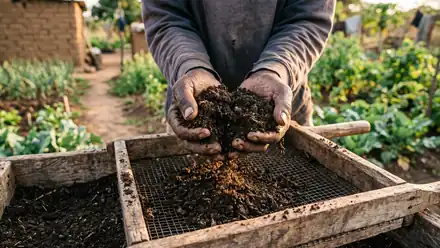
Make your own compost from farm waste
The cheapest soil improver on your farm is the waste you already have. Here's how to turn crop residues and manure into rich compost — and when it pays to buy field-proven compost instead.

The single cheapest way to rebuild tired soil is sitting on your farm already: maize stover, fallen leaves, kitchen scraps and animal manure. Turn them into compost and you return organic matter, nutrients and life to the ground — for the cost of a little labour. Here’s how to make a good batch, and how to know when it’s worth buying compost instead.
Want our free composting and soil guides? Join the mailing list and we’ll send the full set.
What you need: browns and greens
Good compost is a balance of two things (FAO):
- “Browns” (carbon): dry maize stover, straw, dry leaves, small twigs.
- “Greens” (nitrogen): cattle or poultry manure, fresh weeds (before they seed), kitchen scraps.
Aim for a carbon-to-nitrogen ratio of about 30:1 — in practice, roughly two to three parts browns to one part greens by volume. Too many browns and it rots slowly; too many greens and it turns slimy and smells. Chop coarse material to 5–10 cm so it breaks down faster (FAO).
Build the heap
- Build a heap at least 1 metre wide and about 1–1.5 m high (a minimum of roughly 1 cubic metre) so it holds the heat that speeds decomposition (FAO).
- Layer browns and greens like a cake, adding a thin layer of soil or old compost now and then to introduce microbes.
- Water each layer so the heap is as damp as a wrung-out sponge — moist, never soggy.
Turn it, then wait
- Turn the heap every 5–14 days in the first few weeks to let air in and keep it breaking down evenly (Agrodok 8).
- It heats up, then cools as it matures. Most heaps are ready in about 2–4 months.
- It’s ready when it’s dark, crumbly, and smells of clean earth — you should no longer recognise the original materials.
Use it
Work your finished compost into the soil before the rains, so it’s integrated and feeding your crop when planting time comes. Like any organic matter, it improves soil structure, water-holding and fertility, and makes your crop more resilient to dry spells.
When it pays to buy instead
Home compost is the cheapest option — but be honest about its limits: it’s slow, and the quality swings with whatever you put in. Most farms also can’t produce enough to treat a whole field, especially without much livestock manure.
That’s where PCAT BLOCK C Organic Compost fits: it’s standardised, sieved clean and field-proven — the soil-and-moisture core of the SCIT trials in Chirumanzu that reached 18 t/ha maize. Many farmers do both: make what they can at home, and bring in PCAT BLOCK C for consistent quality and the volume a full land needs. Ask us for the right rate for your soil and crop.
Do this now
- Gather your browns and greens — don’t burn that stover.
- Build a heap of at least 1 cubic metre, layered and watered.
- Turn it every week or two and keep it sponge-damp.
- Use the finished compost before the rains.
- Top up with field-proven compost where you need volume or consistency.
PCAT BLOCK C — the locally-made, field-proven compost that rebuilds Zimbabwe’s tired, acidic soils.
Related: see why your soil is probably acidic and how compost fixes it without lime.
Join our free mailing list and we'll send the full 2026/27 calendar plus weekly seasonal tips.