How to maximise your Pfumvudza yields with organic compost
Step-by-step seasonal guide for Pfumvudza and Intwasa farmers: how to prepare planting stations correctly, apply organic compost Zimbabwe-grown, and protect your crop through mid-season dry spells.
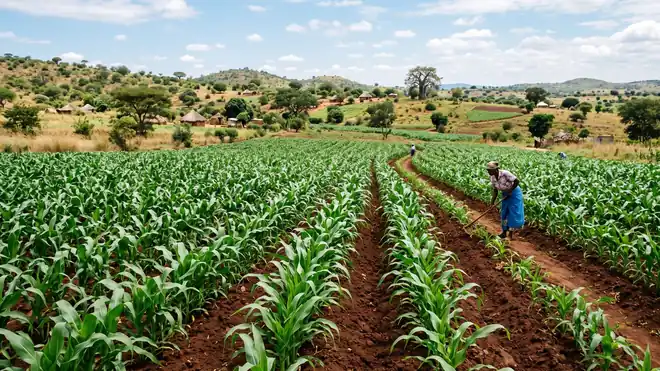
Pfumvudza (Intwasa in Ndebele) concentrates every resource — water, fertiliser, seed, and compost — into a small, precisely managed planting station. That station is where the season is won or lost. What goes into it matters more than almost any other decision you make before the first rains.
This guide is the operational companion to two articles you should read alongside it: the method itself is covered in Pfumvudza and rainwater harvesting, and the soil-science case for putting compost in the station rather than broadcasting across the field is made in compost in the planting station. Rather than repeat those arguments, this guide focuses on the practical sequence — when to dig, how to prepare stations, how to get compost in cleanly, and how that compost protects your crop when a mid-season dry spell hits.
Your season at a glance
| Phase | When | What to do |
|---|---|---|
| Dry-season prep | July–September | Dig stations; soil-test; source compost; apply lime if needed |
| Finishing stations | September–October | Fill with compost–soil mix; mulch the plot |
| Planting | After first effective rain | Drop seed into prepared station; cover lightly |
| After emergence | 2–4 weeks | Top-dress carefully; keep mulch in place; spot-water if needed |
| Mid-season dry spell | January–February | Let the compost in the station work — it’s holding moisture at the root |
1. The station is where the battle is won
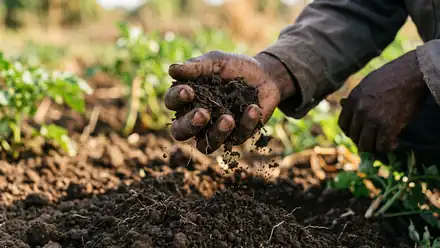
Pfumvudza works because it stops spreading inputs thinly across a whole field and concentrates them where a plant actually roots. The basin catches rainfall and holds it. The mulch stops it evaporating. And the compost in the base of the station acts as a slow-release moisture store and nutrient source directly below the plant.
Miss any one of these layers and you lose most of the benefit. The station is not just a hole in the ground — it’s a micro-environment you engineer before the first rain falls.
Timing is critical. Stations must be dug and filled during the dry season, before the rains begin. This is harder work in dry, firm soil than you might expect — be honest with yourself about how many stations you can properly prepare. A well-made, fully-filled station on a smaller plot outperforms a poorly-made one on a larger plot every time. See preparing your land before the rains for the full July–October checklist.
2. Station preparation, step by step
Layout: work to a regular grid
Pfumvudza stations are laid out on a fixed grid across the plot, not in free-form rows. The grid spacing concentrates plants and captures rain evenly. Agritex recommends 90 cm between rows and 25 cm within the row for high-rainfall areas (Natural Regions I and II), or 90 cm × 30 cm for drier zones (Natural Regions III and IV) (Agritex). Pfumvudza/Intwasa adapts these spacings to the grid of planting stations, with the grid lines marked out before digging begins (FAO).
Mark your rows with a stick or cord before you lift a single hoe. Eyeballing the spacing produces an irregular grid that wastes space and makes mid-season work harder.
Digging the station
Each station is dug as a small, basin-shaped pit. Consistent dimensions matter — stations that are too shallow hold less water and compost; stations that are too deep fill with silt and reduce drainage. The depth and width used consistently in Zimbabwe’s conservation agriculture programme (FAO) create a basin deep enough to hold organic matter and a water reservoir while leaving room for roots to establish easily.
Be honest about the effort. A full plot of properly dug stations is a genuine, multi-day task. Families working together, spreading the work across July and August, finish well ahead of the rains — and that early finish is what lets them plant within hours of the first effective rain, not days.
Do not dig stations during or immediately after rainfall. Wet soil compacts around the station walls and reduces infiltration. Dry-season digging, in firm soil, leaves cleanly-cut walls that stay open.
Mulch: gather it now
Once stations are dug, gather dry grass, maize stalks, or other crop residues and stockpile them near the field. Mulch goes on after planting — 5–10 cm across the station surface and between rows — but it needs to be ready. By October the best material is already brittle and hard to cut. See mulching to beat the dry spells for material selection and application rates.
3. Getting the compost in cleanly — the one-drop method
Once your stations are dug, the next step is filling them with compost mixed into the station soil. This sounds straightforward but there are a few practical techniques that save time, reduce mess, and make sure the compost ends up where it belongs.
We describe our approach as the one-drop method — not an officially tested protocol, but a practical technique developed from working with station application at field scale.
The idea is simple: measure once, drop once, mix once, done. You do not want to be scooping loose compost from a bag on uneven ground, spilling material between stations, or under-filling because you ran out halfway through a row.
How it works with PCAT BLOCK C Organic Compost:
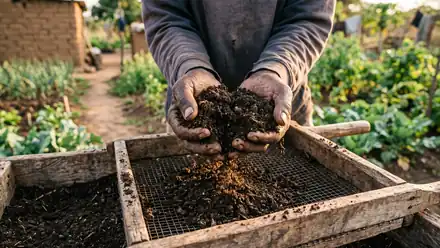
Because PCAT BLOCK C is finely sieved and consistent in texture, it pours cleanly from the bag and sits neatly in the station rather than arriving as lumpy, strawy or stony material that spills or won’t mix. The 50L bag format also makes portioning practical — you can use a standard tin, cup or small container as your measure, establishing a consistent serving size before you start a row, and work through the stations without stopping to weigh or estimate.
Step-by-step:
- Pre-measure your serving size before you start a row. Choose a tin or cup that gives you a consistent, repeatable amount. Do this once, not at every station.
- Drop the compost into the centre of the station — not scattered across the surface. Let it sit in the base.
- Add two to three measures of the station soil (the soil you dug out) on top of and around the compost.
- Mix thoroughly using a stick or the back of the hoe until the compost is evenly distributed through the soil in the station, not sitting as a solid plug at the base.
- Refill to just below the surface, leaving a shallow depression to catch rain.
This produces little spillage and less waste compared with broadcast spreading — and because every grain of compost ends up in the root zone rather than on bare soil between rows, nothing is lost to evaporation or oxidation in the inter-row area.
On per-station quantities: No published, independently verified per-station compost rate currently exists for Zimbabwean field conditions — and we will not invent one. For context, broadcast compost rates for heavy-feeding crops like cabbage run to 20–30 tonnes per hectare (Seed Co) — but station application concentrates a fraction of that volume directly into the root zone, making a much smaller total quantity go significantly further. Message us with your crop and station count and we will advise a conservative starting rate based on the closest available evidence.
4. Mixing and finishing the station
Mix, never plug. The most common station mistake is filling with compost alone and leaving it as a concentrated pocket. A solid compost plug creates drainage problems and can generate enough heat during decomposition to affect young roots. The rule: one part compost to two or three parts station soil, mixed evenly (FAO Soils Bulletin 56).
Use only fully matured compost or manure. Fresh or partially-decomposed material generates heat and ammonia that can damage seedling roots and suppress germination (FAO). Mature compost is dark, crumbly, and earthy-smelling with no identifiable original materials. If you are unsure whether your own material is ready, see using manure without burning your crop. Agritex specifically recommends compost and cured cattle manure for maize soil improvement, listed alongside legume rotation and agroforestry as primary soil-nutrient replenishment methods (Agritex).
Do not over-fill. The station should be refilled to just below the surface level, leaving a slight concave shape to funnel rain into the root zone rather than directing it away.
Mulch immediately after planting. Apply 5–10 cm of dry grass or crop residue across the station and between rows. Mulch above and compost below work together — the compost holds moisture in the soil, and the mulch stops it leaving through the surface. Miss one and you compromise both. See mulching to beat the dry spells.
5. Moisture through the dry spells — the real payoff
Zimbabwe’s mid-season dry spell is the moment that tests everything you did in July and August. Natural Regions III and IV — where a large proportion of communal smallholders farm — are specifically characterised by “severe mid-season dry spells during the rainy season” (FAO). A maize crop wilting at tasselling due to a two-week dry spell is a yield disaster. Compost in the station is your main line of defence.
Why compost holds water. Humus — the stable, dark fraction of mature compost — holds up to 6 litres of water per kilogram, compared with roughly 0.2 litres for the same weight of sandy Zimbabwean soil (FAO). That ratio — 30 times more water-holding capacity per kilogram — is why a compost-filled station continues to supply moisture at the root long after the surface has dried and the inter-row ground is baking. Compost cannot create water. But it holds far more of what does fall, and releases it slowly as the surrounding soil dries.
What Zimbabwe’s SCIT research showed. PCAT engineer Joseph Ngirande, working in collaboration with Harare Institute of Technology, developed the Scientific Conservation Irrigation Technology (SCIT) system over eight years of research. Piloted in Chirumanzu, the system uses plant moisture-conservation potholes filled with organic matter — compost absorbs water and releases it slowly as the soil dries. In those controlled experimental trials, the water requirement was as low as 1 litre per pothole, once per week — a figure only achievable because the organic matter in the station does active moisture-holding work (The Herald (Sallomy Matare), republished by CFU Zimbabwe, 2019). Chirumanzu experimental plots recorded 18 tonnes of maize per hectare under this integrated system (CFU Zimbabwe, 2019).
On the 18 t/ha figure: This is the result from controlled experimental plots using the full integrated SCIT system — specific organic inputs, precise water management, managed plant populations, on research plots in Chirumanzu. It is not a typical smallholder yield expectation. We state that each time because misrepresenting trial figures is how farmers end up with crushed expectations. The principle — that compost in the station holds moisture through dry spells — is what applies to your field today. See the SCIT irrigation system explained for the full picture.
Note on PCAT BLOCK C: The SCIT trial used a specific stick compost and vermicompost mix at a 2:1 ratio (CFU Zimbabwe, 2019). PCAT BLOCK C Organic Compost is a separately formulated, ready-made compost product — not the same as the trial mix, and we will not claim otherwise. What it shares is the underlying principle: biologically active, mature organic compost that holds moisture and feeds the soil at the root zone.
6. Compost, season by season
Pfumvudza is not a single-season fix — it rewards farmers who come back to the same stations year after year. Each season you add compost, the station zone accumulates organic matter. Soil structure improves, water-holding capacity increases, and pH edges slowly upward. Research tracking Zimbabwe’s organic market gardens over 14 years shows measurable pH and available phosphorus gains building steadily with repeated organic inputs (FAO Soils Bulletin 56). Build the system over multiple seasons, not one.
For a full picture of how much organic compost to use by crop type, including the documented broadcast rates for cabbage and tomato, see how much compost per crop in Zimbabwe. Before spending on any input, test your soil first — read your soil before you spend explains where to test and what the numbers mean.
Frequently asked questions
Does premium compost for Pfumvudza stations have to be expensive? Not necessarily — well-made on-farm compost that is fully matured works on the same principle as a bought product. The question is consistency and quality: compost that is lumpy, partially decomposed, or mixed with stones is harder to place neatly in a station and may carry disease or burn risk. Making compost from farm waste covers how to make high-quality compost at low cost. If your on-farm supply is short or unreliable this season, PCAT BLOCK C is a locally-made, finely-sieved ready option available in 50L bags at US$20.
When exactly should I dig my Pfumvudza stations? As early as you can in the dry season — July or August if possible. Dry, firm soil is easier to dig clean stations in than wet or recently-rained-upon soil. Stations dug early can be filled and left before the rains. Stations dug late — October onwards — risk being filled in by early rains before you’ve had a chance to add compost properly.
Can I use fresh cattle manure in the station instead of compost? No. Fresh or partially-decomposed manure generates heat and ammonia that damage or kill young roots (FAO). Use only fully matured compost or well-cured manure. See using manure without burning your crop for curing times and how to tell when manure is ready.
How many bags of organic compost Zimbabwe-grade do I need? That depends on your station count, your crop, and how much material you mix with station soil. No published, verified per-station rate exists for Zimbabwean field conditions — we won’t invent one. Message us with your crop and number of stations and we will give you a conservative estimate.
Does Pfumvudza work for crops other than maize? Yes — the station principle works for sorghum, groundnuts, soya beans, and most vegetables grown in fixed planting positions. The SCIT research found the system suitable for all crops except tobacco and potatoes (CFU Zimbabwe, 2019). Spacings and station sizes will vary by crop. See growing maize in Zimbabwe for maize-specific guidance and the maize planting calendar for Zimbabwe for timing by province and natural region.
Will compost alone fix my acidic soil? Compost has a mild, beneficial buffering effect and the Agritex handbook notes that manure and ash raise soil pH (Agritex). For strongly acidic soil, compost alone is usually not fast enough — Agritex recommends 600 kg/ha of lime once every three years for maize fields in affected areas (Agritex). Compost in stations is a complement to liming, not a replacement. Test your soil first — see read your soil before you spend.
Do this now
- Dig your planting stations this dry season. July or August is ideal. Mark the grid before you start digging. Be realistic about how many stations you can do properly.
- Source fully matured compost now — not at planting time. PCAT BLOCK C is ready to apply. If you’re making your own, start a batch immediately.
- Mix compost into station soil — never fill with compost alone. One part compost to two or three parts station soil, mixed well, filled to just below the surface.
- Use a consistent measure (tin, cup) when portioning compost into stations. Pre-measure before you start a row.
- Mulch the whole plot — 5–10 cm of dry grass or stover — immediately after planting. See mulching to beat the dry spells.
- In dry spells, spot-water at the station — not across the whole plot. The 1 litre/pothole/week SCIT benchmark (CFU Zimbabwe, 2019) shows how little water a well-compost-filled station actually needs.
- Commit to multiple seasons. The compounding benefit to soil structure and water-holding builds over years of repeated organic input (FAO Soils Bulletin 56).
- Message us with your crop and station count for a quantity recommendation — contact us here.
PCAT BLOCK C Organic Compost — locally made, finely sieved, sold in 50L bags at US$20. Made for the station, not for broadcasting.
Related: compost in the planting station — the science · Pfumvudza and rainwater harvesting · preparing your land before the rains · mulching to beat the dry spells · the SCIT irrigation system explained · how much compost per crop in Zimbabwe · read your soil before you spend
- FAO — Conservation Agriculture on a roll in Zimbabwe (Pfumvudza practices and yields)
- Agritex Zimbabwe — Farm Management Handbook (maize spacing, liming, compost and ash as soil inputs)
- The Herald (Sallomy Matare), republished by CFU Zimbabwe — HIT launches new irrigation system (SCIT), 2019
- FAO — How to make and use compost: Sub-Saharan Africa guide (humus water-holding capacity)
- FAO Soils Bulletin 56 — Soil management: compost production and use in tropical and subtropical environments
- Seed Co — Cabbage production guide (broadcast compost rates)
- Seed Co Zimbabwe — Agronomy Manual (conservation tillage, planting timing)
Join our free mailing list and we'll send the full 2026/27 calendar plus weekly seasonal tips.