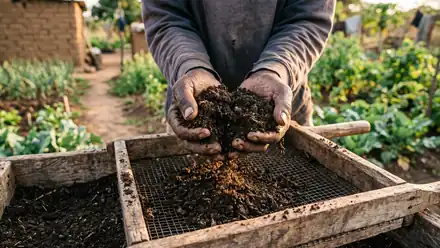
Compost in the planting station: put moisture where the roots are
Why applying compost inside the planting station — not broadcast across the field — saves money, conserves water, and boosts yields. Evidence from Zimbabwe's SCIT research and how to do it with Pfumvudza basins.

Most Zimbabwean smallholders can’t afford to broadcast compost across a whole field. But here’s the better question: do you need to cover the whole field at all?
Research from Zimbabwe says no. Put the compost exactly where the roots are — in the planting station — and a far smaller quantity does far more work. The soil stays moist longer, nutrients sit at the right place, and you stop paying for inputs that do nothing under bare inter-row ground.
This is the practical how-to companion to the SCIT irrigation system. That article covers SCIT as a full system; this one is about its single most actionable idea — one you can apply today with Pfumvudza basins, no specialist equipment required.
Broadcast vs station application: the numbers that matter
| What changes | Broadcast (whole field) | Station / spot application |
|---|---|---|
| Volume of compost needed | High — covers the full surface | Low — only fills each planting station |
| Where nutrients end up | Spread everywhere, including bare inter-row space | Precisely at the root zone |
| Water retention benefit | Diluted across the surface | Concentrated where the plant draws moisture |
| Labour to apply | Heavy spreading across the whole area | Real, but confined to the station |
| Cost per season | Higher per crop planted | Lower per crop planted |
| Works with Pfumvudza/Intwasa? | Not the Pfumvudza method | Yes — this is exactly how Pfumvudza works |
The shift doesn’t mean less effort overall — digging and filling stations is real work, and worth saying plainly. But the effort is concentrated where it pays, and a bag of compost goes much further.
What Zimbabwe’s SCIT research showed
In 2019, PCAT engineer and Harare Institute of Technology lead researcher Joseph Ngirande launched SCIT after eight years of development. PCAT, in collaboration with HIT, piloted the system in Chirumanzu (The Herald (Sallomy Matare), republished by CFU Zimbabwe, 2019).
The core mechanism: plant moisture-conservation potholes filled with organic matter. The compost/manure mix absorbs water and releases it slowly as the surrounding soil dries — a small, living reservoir directly below the plant (CFU Zimbabwe, 2019). The trial fill was stick compost and vermicompost at a 2:1 ratio; worm activity in the vermicompost adds further moisture. Water use: 1 litre per pothole, once a week — a remarkably low figure that only works because the organic matter in the station is actively holding and releasing that water (CFU Zimbabwe, 2019).
On the experimental yield: Chirumanzu experimental plots recorded 18 tonnes of maize per hectare (CFU Zimbabwe, 2019). This is a controlled-trial result — not a typical smallholder expectation. We state that every time we use the figure, because misrepresenting trial data is how farmers end up with crushed expectations. The principle is what applies to your field today.
Inputs are locally sourceable: water, anthill soil, humus, and cattle dung manure. The system works for all crops except tobacco and potatoes (CFU Zimbabwe, 2019). Ivan Craig (AgriSeeds) noted at the launch that most Zimbabwean soils are acidic and the technology can help balance pH — and that yield is determined by plant population per unit area, which this system helps optimise (CFU Zimbabwe, 2019). See read your soil before you spend.
A note on formulation: The SCIT trials used a specific stick compost + vermicompost mix. PCAT BLOCK C Organic Compost is PCAT’s ready-made compost product — a separately formulated product, not the same as the trial fill. We won’t claim otherwise. What it shares is the principle: biologically active organic compost that holds moisture and feeds the soil. For DIY: vermicomposting / worm farming in Zimbabwe and making compost from farm waste.
Why compost holds water
Humus — the stable, dark component of mature compost — can hold up to 6 litres of water per kilogram, against roughly 0.2 litres for a kilogram of sandy Zimbabwean soil (FAO). That’s why compost in the station creates a moisture buffer — water available at the root long after the surface has dried. And because the benefit compounds over seasons, consistent organic inputs improve drought resilience every year you continue (FAO Soils Bulletin 56).
How to do it: step by step
Step 1 — Dig or reuse your stations in the dry season
Dig now, before the rains. Pfumvudza/Intwasa basins are typically around 15 cm deep and 15 cm wide, on a regular grid. If you used basins last season, deepen and refill them — stations accumulate organic matter and improve year on year. See preparing your land before the rains for timing and layout.
Step 2 — Fill the station with compost mixed into soil
Do not fill the station with compost alone. Mix one part compost to two or three parts soil from the hole, and refill to near the surface, leaving a slight depression to catch rain. Mixing extends compost through the root zone and avoids root-burn from concentrated organic matter (see using manure without burning your crop).
On per-station quantities: No published, independently verified figure exists for the optimal per-station volume under Zimbabwean conditions. We won’t invent one. Message us with your crop and station count and we’ll advise based on your situation.
Step 3 — Use only well-matured compost or manure
Fresh or partially-decomposed manure generates heat and ammonia that can damage or kill young roots (FAO). Use compost that is dark, crumbly, and earthy-smelling. Not sure if it’s ready? Using manure without burning your crop covers the tests.
Step 4 — Water precisely and mulch
The SCIT trial used 1 litre per pothole per week (CFU Zimbabwe, 2019). Use this as your low-water benchmark — it works because the organic matter in the station holds and releases that litre to the roots rather than letting it evaporate from bare soil. In the rainy season, the basin catches rain and funnels it into the mix.
Once planted, mulch the surface — 5–10 cm of dry grass, stover, or leaves. Compost and mulch work together: compost holds moisture below, mulch stops it evaporating above. See mulching to beat the dry spells.
How this fits Pfumvudza and Intwasa
If you’re already using Pfumvudza, you’re already doing this. Pfumvudza’s planting basins are station application by another name — concentrating seed, compost, and water at the station rather than broadcasting across the whole plot. What the SCIT research adds is the evidence base for why the compost works so hard in the station: it acts as a moisture store, not just a nutrient source. The 1 litre/pothole/week figure reinforces what experienced Pfumvudza farmers already know — a well-prepared basin with good organic matter carries the plant through a dry spell that would devastate a broadcast-sown field.
Mistakes to avoid
Using fresh manure in the station. Partially-decomposed material burns roots and suppresses germination. Always use fully broken-down compost (using manure without burning your crop).
Filling the station with pure compost. A solid plug without soil mixed in creates drainage problems. Mix one part compost to two or three parts soil.
Letting stations dry out completely. The compost holds moisture — it cannot create it. The 1 litre/week SCIT figure is your minimum in dry conditions; don’t wait for visible wilting.
Skipping the mulch. Compost in the station and mulch on the surface work together. Miss the mulch and you lose much of the moisture benefit through surface evaporation.
Expecting experimental yields immediately. The 18 t/ha Chirumanzu figure (CFU Zimbabwe, 2019) came from controlled experimental conditions with carefully managed plant populations. Build towards it over seasons.
The multi-season compounding benefit
Each season, organic matter accumulates in the station zone. Soil structure improves, water-holding increases, pH edges upward. Consistent organic inputs produce measurable pH and phosphorus gains over years of repeated application (FAO Soils Bulletin 56). Visible soil texture changes typically start within two or three seasons — but treat this as a programme, not a single fix.
See how much compost per crop in Zimbabwe for broadcast application rates, and growing maize in Zimbabwe for the full seasonal approach.
Frequently asked questions
Is station application really different from broadcasting compost across the bed? Yes. Broadcast compost sits under bare inter-row soil where there are no roots, exposed to evaporation and oxidation. Station compost sits in the root zone of every single plant. The SCIT 1 litre/week water figure (CFU Zimbabwe, 2019) is only achievable because the compost in the station is doing active moisture-holding work.
Can I use this for vegetables, not just maize? Yes. SCIT is suitable for all crops except tobacco and potatoes (CFU Zimbabwe, 2019). Station compost application is standard practice for transplanted crops — tomatoes, cabbages, peppers — where the planting position is fixed.
What compost should I use in the station? The SCIT trials used stick compost and vermicompost at a 2:1 ratio (CFU Zimbabwe, 2019). For DIY options see vermicomposting / worm farming in Zimbabwe and making compost from farm waste. For a ready-made option, PCAT BLOCK C is a locally-produced, well-matured compost — not the same formulation as the trial mix, but sharing the same principle of biologically active organic matter that holds moisture and feeds the soil.
How much compost per station? We don’t have a firm, independently published per-station figure for Zimbabwean conditions and we won’t invent one. Message us with your crop and station count and we’ll advise a conservative starting rate.
Does it work in the dry season, and will it help my acidic soil? Yes on both counts. The 1 litre/pothole/week regime (CFU Zimbabwe, 2019) is a dry-season protocol — every drop stays in the compost rather than evaporating from bare soil. On pH: compost has a mild buffering effect over time, and Ivan Craig of AgriSeeds specifically noted that the technology can help balance soil pH (CFU Zimbabwe, 2019). For severe acidity, compost alone may not be fast enough — test first (read your soil before you spend) and consider whether lime is also needed.
Do this now
- Dig stations this dry season — 15 cm deep, on a grid, before the rains come.
- Source well-matured compost now — making compost from farm waste, or order PCAT BLOCK C so it’s ready at planting.
- Mix compost into station soil — one part compost to two or three parts soil; fill to near the surface.
- Water at 1 litre per station per week as your dry-season minimum — the SCIT benchmark.
- Mulch immediately after planting — mulching to beat the dry spells.
- Give it two seasons before judging soil improvement — the compounding effect is real but not instant.
- Message us with your crop and station count for a specific quantity recommendation.
PCAT BLOCK C Organic Compost — PCAT’s ready-made, locally-produced compost, sold in 50L bags at US$20. Put it where it works: in the station, at the root.
Related: the SCIT irrigation system explained · Pfumvudza and rainwater harvesting · how much compost per crop in Zimbabwe · mulching to beat the dry spells · vermicomposting / worm farming in Zimbabwe
- The Herald (Sallomy Matare), republished by CFU Zimbabwe — HIT launches new irrigation system, 2019
- Harare Institute of Technology — EMRECC research projects (SCIT listed among the centre's projects)
- FAO — How to make and use compost (Sub-Saharan Africa guide)
- FAO Soils Bulletin 56 — Soil management: compost production and use in tropical and subtropical environments
- Zimbabwe Farm Management Handbook (Agritex)
Join our free mailing list and we'll send the full 2026/27 calendar plus weekly seasonal tips.