Growing maize in Zimbabwe: the complete guide
How to grow maize in Zimbabwe from land prep to storage — variety choice by natural region, ISFM fertility, weeding, pests and harvest, with every figure sourced.
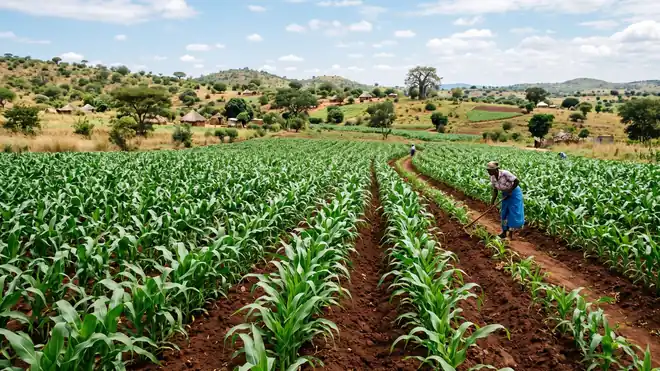
Maize is the backbone of Zimbabwean food security — and one of the most demanding crops to grow well. Nail the variety choice, the planting window, the soil fertility and the weed pressure, and a smallholder in Natural Region II can reach 6–8 t/ha. Miss any one of those levers and you harvest half a crop or less. This guide covers the full season from first planning through to grain storage, with every number sourced so you know exactly what you’re basing decisions on.
This is the maize hub guide. Each section links down to deeper spokes. For the month-by-month calendar of when to plant in your province, start with the maize planting calendar for Zimbabwe — then come back here for the how.
At a glance
| Decision | Recommended figure | Source |
|---|---|---|
| Optimum soil pH | 5.5–6.5 | Seed Co 11 Keys |
| Seed rate | ~25 kg/ha | Agritex |
| Plant population (NRI–NRII) | 45,000 plants/ha (90 cm × 25 cm) | Agritex |
| Plant population (NRIII–NRIV) | 37,000 plants/ha (90 cm × 30 cm) | Agritex |
| Latest safe planting date | Mid-December | Agritex |
| Compound D basal (NRI–NRII) | 300–350 kg/ha | FAO |
| Ammonium nitrate topdressing (NRI–NRII) | 250–300 kg/ha (split) | FAO |
| First topdressing timing | 4–6 weeks after planting (knee height) | Agritex |
| Safe storage moisture | ≤12.5% | Seed Co Agronomy Manual |
Choose the right variety for your region and season
There is no single best maize variety for Zimbabwe — the right hybrid depends on where you farm, how long your rains last, and your management level.
The Agritex handbook groups varieties by season length (Agritex):
- Long-season (140+ days), e.g. SR52, SC701 — suited to high-rainfall NRI and early planting in NRIi where the season reliably carries a full 140 days.
- Intermediate-season (130–140 days), e.g. SC627, ZS255 — the workhorse for most of the prime maize belt.
- Short-season (120–130 days), e.g. SC407, ZS257, SC401 — for drier NRIII and NRIV, where running out of rain is the main risk.
Seed Co’s selection framework adds: the amount and distribution of rainfall in your area, altitude and temperature, your soil fertility, your planting date, and whether pests and diseases are a known pressure in the area (Seed Co 11 Keys). Short-stature varieties can handle slightly higher plant populations and are worth considering where lodging is a common problem.
Open-pollinated vs hybrid: OPVs (open-pollinated varieties) produce cheaper seed you can save for two to three seasons before yield declines. Hybrids deliver higher potential yield, but seed must be bought fresh each season — replanting hybrid seed loses hybrid vigour (Agritex).
Prepare the land before the rains arrive
Maize needs a firm, fine seedbed free of weed trash. Agritex recommends winter ploughing immediately after harvest — it kills weeds, conserves moisture, controls pests, and promotes early decomposition of residues ahead of the season (Agritex). If you’re ploughing in summer before planting, follow with harrowing to create the fine tilth a small maize seed needs.
Conservation tillage — leaving at least 30% of crop residues on the surface after planting — reduces erosion, improves water infiltration, moderates soil temperature in the hot October–November planting window, and builds organic matter over time (Seed Co Agronomy Manual; CIMMYT). If you have compaction from years of shallow ploughing, break it with a ripper or chisel plough at least once every three years (Seed Co 11 Keys).
For the full dry-season land-prep checklist — soil testing, compost timing, Pfumvudza basin digging and mulch gathering — read preparing your land before the rains.
When to plant: read the rains, not the calendar
Maize needs roughly 22 mm of moisture in the soil to germinate evenly. Plant only after a true effective rain — at least 20 mm over about three days, with no dry spell expected for the next ten days. The Meteorological Services Department repeatedly warns against planting on early false showers (The Herald / MSD). The farmer whose crop wilted two weeks after the first October shower planted into a false rain.
Zimbabwe’s five Natural Regions set your planting window (FAO):
- NRI (>1,000 mm): reliable, early rain — plant into the first true rain with a long-season variety.
- NRII (750–1,000 mm): prime maize belt — target full- or intermediate-season hybrids; November planting with the first rains is the safe dryland standard (Seed Co Agronomy Manual).
- NRIII (650–800 mm): marginal — favour medium-season varieties; moisture management is critical.
- NRIV (450–650 mm): drought-prone — short-season or drought-tolerant varieties; don’t wait past your first true rain.
- NRV (<450 mm): erratic — maize is high-risk without irrigation.
Mid-December is the latest safe planting date: yields fall sharply with each week’s delay after that (Agritex). Fields, seed, and fertiliser must be ready in October so you can plant the day the true rains arrive.
Dry planting — sowing 2–3 weeks before the expected first effective rain — is also an option where farmers want to be first in the ground (Agritex). For the full week-by-week timing guide, including province-by-province windows, see the maize planting calendar.
Spacing and plant population
Correct spacing determines how many plants compete for light and water — get it wrong and you either waste land or crowd the crop into lodging and thin ears.
- High-rainfall NRI–NRII: 45,000 plants/ha, achieved with 90 cm between rows and 25 cm between stations (Agritex).
- Drier NRIII–NRIV: 37,000 plants/ha, with 90 cm × 30 cm (Agritex).
- Very dry NRV (tied ridges): 22,000 plants/ha at 1.5 m × 30 cm (Agritex).
- Seed Co recommends 50,000–60,000 plants/ha on all their varieties in high-potential or irrigated conditions (Seed Co Agronomy Manual).
- The absolute minimum plant population is 36,000 plants/ha (Seed Co Agronomy Manual).
- Planting depth: 50 mm is general, but vary with soil type — shallower in heavy soils, slightly deeper in loose sands (Agritex).
- Seed rate: approximately 25 kg/ha (Agritex).
Fertility: the ISFM approach — build the soil, then feed the crop
Integrated Soil Fertility Management (ISFM) is the evidence base for combining organic inputs with right-sized mineral fertiliser rather than choosing one or the other. The logic is straightforward: mineral nitrogen applied to a depleted, low-organic-matter soil has poor efficiency and risks scorching a stressed crop; the same application to soil rich in organic matter holds moisture longer, buffers the nitrogen, and gets used — not lost.
Soil pH first
Maize performs best in pH 5.5–6.5 (Seed Co 11 Keys). Below pH 5.0 in heavy soils, crop failure becomes likely (Agritex). The Agritex recommendation is to lime once every three years, with 600 kg/ha as a general rate — applied after winter ploughing so it has time to react before planting (Agritex). Manure and ash have their own liming effect and should be counted in your soil-health programme.
Before any input, read your soil. A soil test tells you what you’re actually working with, so you lime and fertilise for your real starting point — not a guess.
The organic base
Compost and well-composted manure are the foundation, not the afterthought. The Agritex handbook specifically lists compost and cattle manure among the recommended soil nutrient-replenishing methods for maize, alongside legume rotation and agroforestry (Agritex). Seed Co frames it clearly: Soil Organic Matter (SOM) build-up is one of the 11 keys to achieving high maize yields — more organic matter means better water retention, which is what makes each rain and each topdressing more effective (Seed Co 11 Keys).
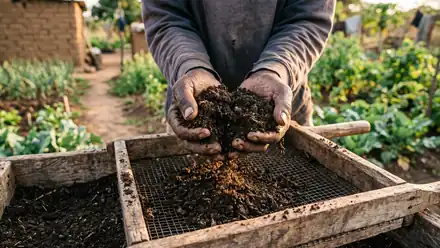
Apply PCAT BLOCK C Organic Compost well before planting — ideally at least a month out during land preparation — so it can incorporate and begin improving soil structure before the first true rain. Work out how much you need with how much compost per crop in Zimbabwe. Prefer to build compost on-farm? See making compost from farm waste. Working with cattle or goat manure instead? Use it without burning your crop.
Compost is not a like-for-like replacement for balanced NPK — maize is a heavy feeder and you will generally still need a basal compound and a nitrogen topdressing. But compost-built soil gets far more out of every kilogram of fertiliser you apply.
Mineral basal and topdressing
Agritex’s general fertiliser recommendation by natural region (FAO):
| Natural Region | Compound D basal (kg/ha) | Ammonium Nitrate topdress (kg/ha) |
|---|---|---|
| NRI–NRII | 300–350 (6–7 bags) | 250–300 (5–6 bags) |
| NRIII | 200–300 (4–6 bags) | 150–200 (3–4 bags) |
| NRIV | 150–200 (3–4 bags) | 100–150 (2–3 bags) |
Apply the whole phosphorus and potassium requirement, plus at least one-third of nitrogen, at planting as a basal dressing (Agritex).
Topdress at knee height — 4–6 weeks after planting — applying into moist soil only. If you’re splitting the topdressing because of high rainfall, apply the first portion at 4–6 weeks and the remainder at 8 weeks after planting (Agritex). Never topdress a drought-stressed crop — the nitrogen won’t move into the root zone and you risk scorching what’s left. This is where compost-rich soil pays for itself: better water retention means the crop stays in good condition longer between rains, widening your safe topdressing window.
See organic vs inorganic fertiliser: what Zimbabwe trials show for the research behind these choices.
Legume rotation: nitrogen for free
Rotating maize with cowpeas, groundnuts, soya or sugar beans is one of the oldest and most effective fertility-maintenance tools in Zimbabwe. Legumes fix atmospheric nitrogen into the soil, improve structure, and break pest and disease cycles. See legume rotations for free nitrogen for the full practical guide.
Weed management
A maize crop must be weed-free for at least 2–6 weeks after establishment to protect the yield (Agritex). Weeds in that early window compete directly with young plants for moisture and nutrients — every day of uncontrolled competition in the first month chips away at the final yield.
Three weed control approaches are used in Zimbabwe: hand-hoeing, mechanical cultivation between rows, and herbicides (Atrazine being the most commonly recommended pre-emergence chemical for maize, often combined with mechanical inter-row cultivation to halve the chemical rate) (Agritex). Soil covered with compost mulch suppresses weed germination and saves at least one weeding pass — see mulching to beat dry spells for how to do this effectively.
Pests and diseases
Fall armyworm — scout from emergence
Scout at least twice a week from crop emergence, checking the funnel of each plant for damage and larvae. Early detection is the difference between a spot-treatment and a lost stand. The full scouting and organic-first control playbook is in beating fall armyworm the organic way.
Major diseases to watch
The key maize diseases in Zimbabwe include leaf blight, grey leaf spot, boil smut, rust, and maize streak virus (MSV). Most are managed primarily through resistant varieties, crop rotation, and good field hygiene rather than chemical sprays (Agritex). See common maize diseases in Zimbabwe for identification, timing and management.
Harvest, drying and storage
When to harvest
Plan for your harvest window well in advance — Seed Co advises that combines should have a health check in April–May and be booked early (Seed Co Agronomy Manual). Harvesting and drying can begin when grain moisture reaches 20% or below (Seed Co Agronomy Manual).
Drying
Maize can be dried artificially or naturally. In natural drying, cobs are left on the standing plant and, on small plots, the sheath can be opened to speed drying (Agritex). Watch for mycotoxin risk if grain stays damp on the stalk too long in humid conditions.
Safe storage moisture
The acceptable moisture level for effective storage is 12.5% or below (Agritex; Seed Co Agronomy Manual). Grain stored above this level is vulnerable to weevils, moulds and aflatoxin. For full grain storage advice — from moisture testing and hermetic bags to traditional grain protectants — see storing maize without losing it.
Frequently asked questions
What is the best maize variety for Zimbabwe? There is no single answer: the right variety depends on your Natural Region, expected season length, and management level. Long-season hybrids like SC701 suit high-rainfall NRI and early NRII plantings; short-season varieties like SC407 are safer in drier NRIII–NRIV. Match variety to rainfall first, then yield potential. See the maize planting calendar for region-by-region guidance.
How much fertiliser does maize need in Zimbabwe? Agritex’s general rate for NRI–NRII is 300–350 kg/ha of Compound D at planting, plus 250–300 kg/ha of Ammonium Nitrate split across two topdressings (FAO). Drier regions use less. But these are conventional baselines — your actual need depends on your soil’s starting fertility. Test first, build organic matter with compost to improve fertiliser-use efficiency, and adjust accordingly. Message us with your crop size for a tailored recommendation.
Can I grow maize without mineral fertiliser? Compost, manure, legume rotation and agroforestry practices all contribute nitrogen and improve fertility — and Agritex lists them explicitly as maize fertility tools (Agritex). However, to reach higher yield targets, most farmers in Zimbabwe’s prime regions still pair organic matter with a mineral basal and topdressing. The ISFM model treats compost as the soil-health foundation that makes mineral inputs more efficient — not a swap for them.
What spacing should I use for maize? In NRI–NRII: 90 cm between rows, 25 cm between stations (45,000 plants/ha). In NRIII–NRIV: 90 cm × 30 cm (37,000 plants/ha). Short-stature varieties can handle slightly higher populations (Agritex).
When should I topdress maize? At knee height, 4–6 weeks after planting, into moist soil — not onto a drought-stressed crop. A second portion of nitrogen can go on at 8 weeks if you’re splitting the topdressing (Agritex). Soil with good organic matter holds moisture longer and gives you a wider safe window for topdressing.
What is the biggest risk in maize storage? Storing grain above 12.5% moisture, which opens the door to weevils, moulds and aflatoxin. Dry thoroughly before bagging, treat with an approved grain protectant, and check regularly. See storing maize without losing it.
Do this now
- Choose your variety now — match season length to your Natural Region before seed sells out.
- Get a soil test if you haven’t in three years — know your pH and fertility before you buy a single bag of input. See read your soil before you spend.
- Apply compost or manure during land preparation — at least a month before your expected planting date — so it’s incorporated and improving soil structure when the rains arrive. PCAT BLOCK C is the ready-to-use option.
- Have seed, lime, basal fertiliser and topdressing on hand before November — fields, inputs and equipment must be ready so you plant the day the effective rains come.
- Plant at the right spacing for your region — 90 cm × 25 cm for NRI–NRII, 90 cm × 30 cm for NRIII–NRIV.
- Topdress at knee height, into moist soil — not earlier, not later, never onto a stressed crop.
- Scout for fall armyworm twice a week from emergence — catch it early.
- Dry to 12.5% before storage and treat grain before bagging.
PCAT BLOCK C — the locally-made, field-proven compost that rebuilds Zimbabwe’s tired, acidic soils and makes every fertiliser input work harder.
Related: maize planting calendar for Zimbabwe · beating fall armyworm the organic way · common maize diseases in Zimbabwe · storing maize without losing it · legume rotations for free nitrogen · how much compost per crop in Zimbabwe
- Agritex Zimbabwe — Farm Management Handbook (maize agronomy section)
- Seed Co Zimbabwe — Agronomy Manual (plant populations, planting time, harvest)
- Seed Co Zimbabwe — 11 Keys to Achieve 11 t/ha Maize
- FAO — Fertilizer use by crop in Zimbabwe (natural region recommendations)
- FAO — Zimbabwe country brief
- CIMMYT — Conservation agriculture for sustainable cropping (MDPI, 2015)
Join our free mailing list and we'll send the full 2026/27 calendar plus weekly seasonal tips.