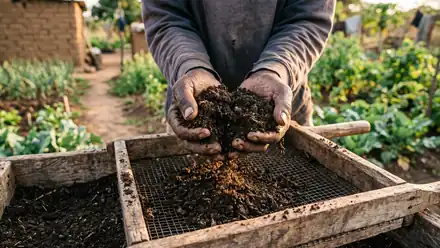
Organic vs inorganic fertiliser: what Zimbabwe's trials actually show
Organic vs inorganic fertiliser in Zimbabwe, compared honestly using local trial data — what mineral fertiliser does well, where it fails on sandy acid soils, and why compost is the foundation, not a replacement.

“Organic or inorganic?” is the wrong question on most Zimbabwean fields. The honest answer, backed by decades of local trial data, is that they solve different problems — and the farmers getting the best yields tend to use both, deliberately. Here’s what the research actually shows, so you can spend your money where it works.
Short version: mineral fertiliser feeds the crop fast; compost and manure feed the soil — its structure, water-holding and biology — over seasons. On Zimbabwe’s sandy, acidic, carbon-poor soils, skipping the second half of that equation is why so many bags of fertiliser under-deliver.
The soil most of us are actually farming
Roughly 70% of Zimbabwe’s soils are granite-derived sandveld — light, free-draining, and naturally low in organic matter and nutrient-holding capacity (Farm Future Africa). Layer four decades of ammonium-based fertiliser on top without matching lime, and acidity compounds. In a classic study of high-potential communal areas, the share of soils at pH 5.0 or below (CaCl₂) rose from 42% in 1982–84 to 77% by 1992–94, and 56% of soils by the 1990s needed liming, up from 26% a decade earlier (Nyamangara & Mpofu). At pH 4.5 or below, 43% of soils showed aluminium toxicity and phosphorus deficiency severe enough to blunt any fertiliser you apply (Nyamangara & Mpofu).
That’s the backdrop against which “organic vs inorganic” gets decided here — not on paper, but on soil that’s often already fighting you.
What mineral fertiliser does well
Give it its due — mineral (inorganic) fertiliser is precise, fast-acting and easy to budget in kilograms per hectare. Companies like ZFC sell ready blends built for specific crops — Cereal Blend 14:28:14, Vegeblend 9:24:20, Soyablend 6:27:20 (ZFC) — letting a farmer apply an exact, known quantity of N, P and K at planting or top-dressing. On soil with reasonable structure and organic matter already, that precision pays: nutrients are available almost immediately, and response is measurable within weeks.
Where it struggles is everything it was never designed to do:
- It adds no organic matter. NPK granules carry nutrients, not carbon, humus or biology — none of the structure-building the soil itself needs.
- It can accelerate acidification. Ammonium-based nitrogen is acidifying with repeated use — the exact decade-long trend documented above.
- Its efficiency collapses on sour soil. Correcting pH through liming has been shown to sharply lift N and P fertiliser-use efficiency — in Zimbabwean trials, liming acidic communal-area soils raised maize grain yield by 0.6 to 2.64 t/ha, with gross margin gains of 6% to 68% over unlimed plots (Dhliwayo et al.). The same fertiliser bag pays back far less on unlimed sand than on healthy soil.
- Cost and forex exposure. Imported fertiliser is priced in hard currency and its availability tracks the exchange rate — a real constraint most smallholders manage every season.
What compost and manure do well — and honestly, what they don’t
Organic matter’s job is different, and it’s worth being precise about it rather than overselling it.
What it does:
- Builds structure and water-holding. Humus binds sandy particles together and opens pore space in clay — FAO puts it plainly: 1 kg of humus can hold up to 6 litres of water (FAO). In an Ethiopian comparison in the same FAO guide, compost-grown crops kept growing for roughly two weeks longer after the rains stopped than crops on chemical fertiliser alone.
- Feeds soil biology and buffers pH. Cattle manure at 10, 20, 40 and 80 t/ha progressively raised soil pH on Zimbabwean sands in trial work (Dhliwayo et al.) — slower and gentler than lime, but a genuine acidity-management tool where lime is unavailable or unaffordable.
- Releases nutrients slowly. Compost supplies N, P and K as it mineralises through the season, rather than all at once — a different release profile, not a faster one (FAO Soils Bulletin 56).
What it doesn’t do:
- It is not a like-for-like NPK swap. Bag for bag, compost delivers far less concentrated nutrient than mineral fertiliser, and its exact content varies with what went into it. Don’t plan a season assuming compost alone matches a mineral programme’s nutrient supply.
- Volume and quality are real constraints. Most households can’t produce enough home compost or manure to treat a full hectare at trial rates, and quality swings with the materials available.
- It works over seasons, not weeks. Structural and biological gains compound over years of use — closer to an investment than a quick fix.
Where the two are shown working together
This is what the “organic vs inorganic” framing usually misses: Zimbabwean field trials increasingly test them together, not as rivals.
A 2022–23 tomato trial at Midlands State University compared six strategies — unfertilised control, 100% NPK, three blends stepping down NPK while stepping up cow manure (80% NPK + 5 t/ha manure, through to 40% NPK + 15 t/ha), and manure alone at 20 t/ha. The blended treatments consistently outperformed either sole mineral fertiliser or sole manure on yield and vegetative growth, though manure alone at 20 t/ha also performed strongly (Mutetwa et al.). That’s integrated soil fertility management (ISFM) in a Zimbabwean field: less mineral fertiliser, not zero, plus organic matter, beats either extreme.
The same logic holds beyond fertiliser type. A 14-year, on-farm conservation agriculture study across Zimuto (Zimbabwe) and Zidyana (Malawi) found CA systems — which build soil carbon over time — out-yielded conventional tillage in most seasons, with net economic benefits of US$193–444/ha and labour savings of 34–42 days/ha in Malawi, while the Zimbabwean site recorded rising soil carbon and infiltration alongside the yield gains (Thierfelder et al.).
On acid-sensitive crops the pattern repeats: Zimbabwean groundnut trials found liming with calcitic or dolomitic lime at 2,000–4,000 kg/ha lifted kernel yield by as much as 319% over unlimed plots, by raising pH and correcting calcium and magnesium deficiency (University of Pretoria) — proof that on genuinely sour soil, pH correction has to happen before any fertiliser programme can pay its way.
Quick comparison
| Mineral (inorganic) fertiliser | Compost / manure | |
|---|---|---|
| Nutrient release | Fast, precise, measurable in weeks | Slow, gradual, over a season+ (FAO) |
| Soil structure & water-holding | No effect | Builds both; 1 kg humus holds up to 6 L water (FAO) |
| Soil pH over repeated use | Ammonium sources tend to acidify soil (Nyamangara & Mpofu) | Gently buffers/raises pH over time; manure at 10–80 t/ha raised pH in Zim trials (Dhliwayo et al.) |
| Soil biology | No direct contribution | Feeds microbial activity that cycles nutrients |
| Fertiliser-use efficiency it protects | Depends on soil pH being corrected first | Improves the soil that fertiliser then works in |
| Volume needed for a hectare | Precise, budgetable kilograms | Often more than smallholders can produce alone |
| Cost exposure | Forex-linked, import-dependent | Can be made on-farm; standardised product removes the quality-variance risk |
| Best evidence for combining | 40–80% NPK + manure outperformed either alone in tomato trial (Mutetwa et al.) | Same trial |
Frequently asked questions
Is organic fertiliser actually better than inorganic in Zimbabwe? Neither wins outright — they do different jobs. Zimbabwean trials consistently show combined organic-plus-reduced-mineral approaches outperforming either used alone (Mutetwa et al.). Ask “what does my soil need first,” not “which is better.”
Can compost replace my mineral fertiliser completely? Not reliably, and we won’t tell you it can. Compost is the soil-health foundation — structure, water-holding, biology, slow release — not a matched NPK substitute. Most farmers get the best results using compost to build the soil and mineral fertiliser (often at reduced rates) to top up specific nutrients.
My soil is already very acidic — should I lime or compost first? If pH is badly depressed (below about 4.5) and lime is available, lime works faster on pH specifically (Dhliwayo et al.). Where lime is hard to source, organic matter raises pH more gradually while rebuilding structure and biology too. Many farmers do both over time.
How much compost should I apply to see these benefits? It depends on your crop and soil condition — we won’t quote a number that isn’t backed by data for your situation. Cabbage responds well to 20–30 t/ha (Seed Co), and trial manure rates elsewhere have ranged from 5 t/ha (blended with reduced NPK) up to 20 t/ha alone (Mutetwa et al.). See our full compost rates by crop guide, or message us with your crop and land size and we’ll advise a rate.
Is compost quicker to see results from than lime? No — lime acts faster on pH specifically. Compost’s advantages build over a season and compound over years; 14-year data from Makoni gardens shows pH and phosphorus availability climbing steadily over a decade of consistent organic management, not overnight (Tumbure et al.).
Do this now
- Test your soil pH before choosing anything — see read your soil before you spend.
- If pH is badly acidic, address it first — via lime where available, or organic matter over time. Read understanding soil acidity in Zimbabwe.
- Plan an integrated programme, not a binary choice — organic matter for structure and biology; mineral fertiliser (often reduced) for precise nutrient top-up.
- Work compost or well-rotted manure into your beds before the rains — see making compost from farm waste and using manure without burning your crop.
- Don’t guess your organic rate — message us with your crop and land size, or see how much compost per crop.
PCAT BLOCK C — the locally-made, field-proven compost that builds the soil health your fertiliser programme depends on. Not a fertiliser replacement — the foundation underneath one.
PCAT BLOCK C Organic Compost · Related: how much compost per crop · understanding soil acidity in Zimbabwe · cover crops and green manures · growing tomatoes in Zimbabwe
- Nyamangara & Mpofu (1996) — Soil pH and lime requirement for high-potential communal areas of Zimbabwe (JASSA)
- Dhliwayo et al. (1999) — Liming in Zimbabwe: a critical look at recovery from acid soil infertility (Soil Fert Net / CIMMYT working paper)
- University of Pretoria — The impact of soil acidity amelioration on groundnut production on sandy soils of Zimbabwe (PhD thesis)
- Mutetwa et al. (2025) — Integrating organic and inorganic fertilizers for climate-smart tomato production in Zimbabwe (EUREKA: Life Sciences)
- Thierfelder et al. — Evidence and lessons learned from long-term on-farm research on conservation agriculture in Malawi and Zimbabwe (MDPI Agriculture)
- FAO Soils Bulletin 56 — Soil management: compost production and use in tropical and subtropical environments
- FAO — How to make and use compost (Sub-Saharan Africa guide)
- ZFC — Customer-specific fertiliser blends (conventional NPK reference)
- Farm Future Africa — Understanding soil pH and how to fix it
- Seed Co — Cabbage production guide (compost, manure and chicken-litter rates)
- Tumbure et al. (2024) — 14-year soil fertility trajectories in smallholder organic market gardens, North-East Zimbabwe (preprint)
Join our free mailing list and we'll send the full 2026/27 calendar plus weekly seasonal tips.