Biochar for Zimbabwe's sandy soils: what the evidence says
Biochar Zimbabwe: what it is, what the Mutare district field trial actually showed, how to make it low-tech, why you must charge it with compost first, and its real limits on sandy soils.
Biochar is receiving a lot of attention online — some of it useful, some of it breathless. This article gives you what the actual evidence says, including the caveats that the promotional material tends to skip, and what a recent Zimbabwean field trial in Mutare District genuinely found.
The short version up front: Biochar is a soil conditioner — primarily carbon — that can improve water-holding, cation exchange capacity (CEC) and pH on sandy, acidic soils. It is not a fertiliser. Applied raw on its own, it can actually tie up nitrogen and reduce crop uptake in the short term. The evidence from sandy soils like Zimbabwe’s is generally encouraging but still limited. If you use it, charge it with compost or manure before applying.
Before you spend anything on soil inputs, read your soil first. No amendment — biochar included — pays if you don’t know what you’re correcting.
What biochar does — and what it does not do
| What biochar CAN do (cited) | What biochar CANNOT do |
|---|---|
| Increase soil CEC — hold more nutrients in the root zone (Mujere et al., 2025) | Replace fertiliser. It carries very little plant-available N, P or K on its own |
| Improve water-holding in sandy soils (Mujere et al., 2025) | Replace compost or manure as a source of organic matter and slow-release nutrients |
| Raise soil pH (liming effect from ash content) — especially useful on acidic sands (Mashamaite et al., 2024) | Guarantee yield gains — response varies hugely by feedstock, pyrolysis temperature, soil type and application rate (Davys et al., 2023) |
| Create pore habitat for soil microbes (Mashamaite et al., 2024) | Work well raw — fresh/uncharged biochar can immobilise soil nitrogen short-term (Davys et al., 2023) |
| Persist in soil for decades, giving long-term structural benefit (Mashamaite et al., 2024) | Offset poor soil management — it adds to good practice, it doesn’t replace it |
What is biochar?
Biochar is organic material — crop stover, wood, manure, leaves — heated to temperatures typically between 300 and 700 °C in a low-oxygen environment (pyrolysis) (Mujere et al., 2025). The result is a stable, carbon-rich char that resists decomposition and can remain in soil for decades or longer, unlike compost which mineralises within a season or two.
Its key physical property is porosity: biochar is riddled with tiny pores that give it a large surface area. These pores can hold water and nutrients against leaching, and provide habitat for beneficial soil microbes. The liming effect comes from the alkaline ash content of most biochars — legume-derived biochars (like cowpea stover) tend to raise pH more than wood-derived ones (Mujere et al., 2025).
However — and this matters — different feedstocks, different pyrolysis temperatures and different soils produce very different results. A biochar that works well on one farm may produce no measurable benefit on another (Davys et al., 2023). This variability is a reason for honest caution, not a reason to dismiss it.
Why Zimbabwe’s sandy soils are where biochar makes most sense
About 70% of Zimbabwe’s soils are granite-derived — sandy, light and naturally low in organic matter and fertility (FAO). As we cover in detail in understanding soil acidity in Zimbabwe, many communal-area fields sit at a pH of 4.2–4.5 with widespread aluminium toxicity and phosphorus lock-up. These soils also drain quickly and hold nutrients poorly.
That is almost the textbook case for where biochar shows its most consistent benefits in the published literature:
- Sandy soils have naturally low CEC — anything that adds surface area and binding sites for nutrients helps (Mashamaite et al., 2024).
- Sandy soils drain water fast — improved water-holding is immediately valuable.
- Low pH soils respond to the liming effect of biochar’s ash content.
- Tropical, smallholder sandy soils showed higher crop productivity responses to biochar than clay, loam or silt soils in several studies (Mujere et al., 2025).
The flip side: sandy soils are also where the risk of nutrient tie-up from fresh biochar is more acute, because there is less organic matter buffering the system.
What the Zimbabwean evidence actually shows
The most directly relevant published trial we could verify is:
Mujere, L., Mvumi, C., Musabayana, Z. and Mathema, N. (2025). “Biochar types mixed with organic and inorganic fertilizer boost maize growth and yield in sandy arid belts of Zimbabwe.” International Journal of Plant Physiology and Biochemistry. DOI: 10.5897/ijppb2024.0321
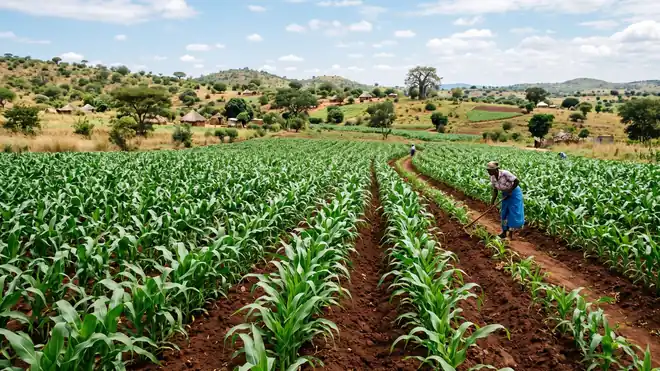
The trial was conducted in Munyarari communal area, Ward 20, Mutare District — classified in Natural Region III (hot, dry, ~671 mm annual rainfall) on sandy loam orthoferrallitic soils typical of much of Zimbabwe’s smallholder farming landscape.
What they tested: Three biochar feedstocks — cowpea stover, maize stover, and msasa leaves — each mixed with cattle manure and Compound D inorganic fertiliser, applied at 8 t/ha in planting basins using the Pfumvudza conservation agriculture approach. The control was cattle manure plus Compound D without any biochar. Note: all treatments included manure and inorganic fertiliser — this was a comparison of biochar type within an integrated system, not biochar alone versus nothing.
What they found:
- All three biochar types significantly increased maize growth (plant height, leaf length, stem girth, cob length) and grain yield compared to the manure-plus-fertiliser control (P < 0.001).
- Cowpea stover biochar produced the highest grain yield: 5.67 t/ha, against 2.47 t/ha for the control — a 56% increase.
- Maize stover biochar was second most effective; msasa leaf biochar showed the least improvement, though still positive.
- The authors attributed the gains to improved water-holding during a dry season (plants in biochar plots showed less drought stress at key growth stages), increased CEC, improved phosphorus availability as pH rose, and the high nitrogen content of cowpea-derived char.
What to note honestly:
- This was a single-site, single-season trial in one communal area. Replication across sites and seasons would strengthen the evidence considerably.
- The control already used cattle manure and inorganic fertiliser — so the baseline was not “nothing.” The 56% yield increase was on top of an already-fertilised baseline.
- The study does not report soil-only biochar treatments (biochar without manure or fertiliser), so it cannot tell us what biochar would do applied alone on degraded soil without other inputs.
- The study was conducted in a particularly dry season, which likely amplified the water-holding benefit — results may differ in wetter years.
Broader regional evidence: A 2024 review of biochar research across Sub-Saharan Africa smallholder farming (Mashamaite et al., 2024) found that biochar consistently improved soil physical, chemical and biological properties on sandy, degraded soils in the region — but also flagged that response sizes were strongly dependent on biochar feedstock, pyrolysis conditions, application rate and soil characteristics. Not all trials showed yield gains, and the review identified this variability as a key research gap.
The critical limit: fresh biochar can tie up nitrogen
This is the part that online biochar promoters often skip.
Fresh biochar — especially biochar produced at lower temperatures or from high-carbon feedstocks — can contain what researchers call “labile” (easily degradable) carbon. When this reaches the soil, it fuels a burst of microbial activity. Those microbes draw nitrogen from the soil to decompose the labile material, effectively immobilising it and making it temporarily unavailable to your crop. The result can be reduced nitrogen uptake and lower yield in the short term, the opposite of what you intended (Davys et al., 2023).
This risk is not universal — biochars produced at higher temperatures tend to have less labile carbon — but it is well-documented and real enough to take seriously.
The practical answer is charging, covered below.
How to make biochar at small scale — three cited methods
If you have access to crop residues and are willing to invest the labour, small-scale on-farm biochar production is possible. Researchers have evaluated three low-tech methods suitable for rural settings (Vaditya et al., 2025):
1. The Kon-Tiki (cone pit) method Dig a conical pit in the ground — roughly 30 cm inner diameter, 45 cm deep, 75 cm outer diameter as a starting point (scale up with more material). Line the circumference with bricks or clay-soil mix to retain heat. Ignite a layer of dry residue at the bottom, then feed subsequent layers on top as each layer begins to char black. Adding layers suppresses oxygen and prevents the char from combusting further. Once all material has turned black (not ash — black), quench with water to stop the process. Let cool, then collect the biochar.
2. The trench method Dig a trench, fill with dried residues and ignite. As material chars, add further layers and restrict air supply. Quench with water once charring is complete.
3. The TLUD (Top-Lit Updraft) method A metal drum or cylinder with air holes at the base and an open or restricted top. Feedstock is loaded, lit from the top, and burns downward through the material in a low-oxygen environment, producing biochar at the base.
The Mujere et al. trial used a modified metal drum (200 L capacity, 58 cm diameter, 86 cm height) at an estimated pyrolysis temperature of around 600 °C (Mujere et al., 2025).
Safety and environment — do not skip this:
- Do not burn residues that are more valuable elsewhere. Crop stover used for biochar cannot also be used for mulch, livestock feed or soil cover. Given that mulching is one of the cheapest ways to beat dry spells — read mulching to beat dry spells — this is a real trade-off. Only make biochar from residues that genuinely have no better use: stems too woody for mulch, invasive weeds, prunings.
- Do not cut living trees for feedstock. Use agricultural residues only.
- Be mindful of smoke. Pyrolysis produces smoke. Work in open, ventilated areas away from dwellings, and follow any local regulations on burning.
- Check local rules. Open burning may require a permit or be restricted at certain times of year in your district.
Charging: why you should never apply biochar raw
Given the nitrogen-immobilisation risk described above, the consensus across current research is to charge biochar before applying it to the field — either by mixing it into your compost heap as it is being built, or by soaking it in manure slurry or compost tea before use.
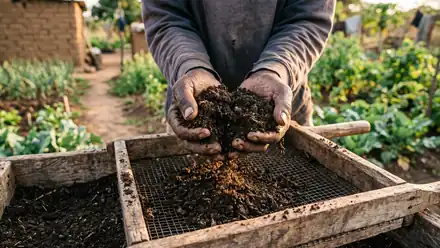
When biochar is co-composted with organic matter from the start, something useful happens: the composting process loads the biochar’s pores with nutrients, microbial communities and organic compounds. The result — sometimes called COMBI (co-composted biochar) — has been shown to outperform both plain compost and plain biochar applied separately, and also to outperform simply mixing finished compost with finished biochar (Antonangelo et al., 2021). The co-composting process improves both products: biochar’s CEC increases as it ages in the compost, and compost quality improves because the biochar reduces nitrogen losses as gas during decomposition.
Practically, for a smallholder:
- When you build your compost heap, add your biochar to the heap at the layering stage — roughly in the middle layers — and let it mature with the rest of the compost. See making compost from farm waste for how to build a good heap.
- Alternatively, soak your biochar in diluted cattle manure slurry for a week before applying it. This pre-loads the pores and removes the immediate nitrogen-immobilisation risk.
This is the natural pairing point for compost in the system. PCAT BLOCK C Organic Compost is the standardised compost you can mix biochar into, or co-apply with charged biochar as part of an integrated organic soil programme. To be clear: PCAT BLOCK C does not contain biochar and has not been tested in combination with it. Our independent NPK analysis is still with the laboratory. What it does provide is the mature, stabilised organic matter that makes biochar work better — not raw, not hungry, not liable to tie up your nitrogen.
How much to apply — and where the evidence is thin
This is where we have to be honest: there is no established, replicated Zimbabwean biochar application rate for most smallholder crops.
The Mujere et al. trial used 8 t/ha applied in planting basins as a one-time spot application (Mujere et al., 2025). That figure is informative but comes from one site and one season. Global trials have used rates ranging from 1 to 50+ t/ha, with the highest rates sometimes showing diminishing returns or even negative effects at very high applications.
What we recommend:
- Do a soil test first — see read your soil before you spend. Biochar’s liming and CEC effects are most valuable on soils below pH 5.5 with very low organic carbon. If your soil is already at a reasonable pH and organic matter level, the benefit may be marginal.
- Where no firm Zimbabwean rate exists for your crop and context, the Mujere et al. trial figure of 8 t/ha (applied in stations, not broadcast) is a reference point — not a recommendation. Spot application in planting stations is more practical and economical than broadcast application.
- Because biochar is largely permanent in the soil, start conservatively. A one-off application at a modest rate allows you to observe the response over multiple seasons before committing to higher rates.
- Do not invent a rate. If you’re unsure, message us with your crop and soil situation.
Frequently asked questions
Is biochar a fertiliser? No. Biochar is primarily carbon. It does not supply the nitrogen, phosphorus and potassium your crop needs at agronomic rates. It is a soil conditioner — it improves the soil’s capacity to hold and make available the nutrients you supply through other means. Treating it as a fertiliser substitute will disappoint you.
What feedstocks work best for Zimbabwe conditions? The Mutare District trial found cowpea stover biochar outperformed maize stover and msasa leaves (Mujere et al., 2025). The authors attribute this partly to the leguminous nature of cowpea biomass — roots with nitrogen-fixing nodules, higher nitrogen content. Cowpeas are widely grown in drier parts of Zimbabwe, making their stover a practical feedstock. Maize stover biochar was the second most effective. This does not mean msasa or other feedstocks won’t work — it means we have limited data.
Can I just buy biochar rather than make it? If commercially produced biochar of known quality becomes available through local agro-dealers, and the cost makes sense for your return, that is a reasonable option. At present (August 2026), we are not aware of a standardised, quality-assured commercial biochar product widely available to Zimbabwean smallholders. If you make your own, the drum method used in the Mujere et al. trial is documented and replicable.
Will biochar fix my soil acidity? It can help — most biochars have alkaline ash content and a modest liming effect. But if your soil is severely acidic (below pH 4.5), biochar alone is unlikely to correct it quickly. Read understanding soil acidity in Zimbabwe for what actually works on very acid soils. Biochar is a useful complementary tool, not a standalone fix.
Should I stop using compost if I add biochar? Absolutely not — in fact, the evidence says the opposite. Biochar and compost work better together than either alone (Antonangelo et al., 2021). Compost is the organic matter your soil needs as food for biology, structure-building and slow nutrient release. Biochar extends those benefits by holding them in the soil longer. See how much compost per crop in Zimbabwe for compost rates by crop.
Do I need biochar at all? Not necessarily. For most Zimbabwean smallholders, the highest-return investments in soil health are still compost or well-rotted manure, mulching and correcting soil acidity. If those are already in place and you have access to surplus residues unsuitable for mulch, biochar is a promising next step. If your soil is still severely depleted and you can’t reliably compost, fix that first.
Do this now
- Test your soil (read your soil before you spend) before adding any new amendment. Biochar adds most value on soils below pH 5.5 with very low organic carbon.
- Make biochar from residues that have no better use — surplus stems, prunings, material too woody for mulch. Do not burn stover or residues that would be better returned as mulch or fed to livestock.
- Charge it before it goes near your field — mix it into your compost heap or soak it in manure slurry for at least a week. Raw biochar risks tying up your nitrogen.
- Apply it in combination with organic matter and fertiliser, as the Mutare trial did — not as a sole input. Spot application in planting basins is more practical than broadcast for most smallholders.
- Start conservatively — biochar is largely permanent, so a modest first application at roughly 5–8 t/ha in your planting stations lets you judge the response over seasons before committing more.
- Don’t skip the compost — see making compost from farm waste and consider PCAT BLOCK C Organic Compost as the mature organic matter to pair with any biochar programme.
PCAT BLOCK C — locally-made, stabilised compost that gives your sandy soil the organic matter biochar can’t supply on its own. Pair them honestly: charge the biochar in the compost, then feed your soil both.
Related: understanding soil acidity in Zimbabwe · organic vs inorganic fertiliser: what Zimbabwe’s trials show · mulching to beat dry spells · using manure without burning your crop · vermicompost vs compost vs bokashi
- Mujere et al. (2025) — Biochar types mixed with organic and inorganic fertilizer boost maize growth and yield in sandy arid belts of Zimbabwe (International Journal of Plant Physiology and Biochemistry / AcademicJournals)
- Mashamaite et al. (2024) — Assessing the Potential of Biochar as a Viable Alternative to Synthetic Fertilizers in Sub-Saharan Africa Smallholder Farming: A Review (MDPI Agronomy)
- Davys et al. (2023) — The Effect of Different Biochar Characteristics on Soil Nitrogen Transformation Processes: A Review (MDPI Sustainability)
- Antonangelo et al. (2021) — The roles of co-composted biochar (COMBI) in improving soil quality, crop productivity, and toxic metal amelioration (Journal of Environmental Management)
- Vaditya et al. (2025) — Production of biochar with different crop residues by conventional methods: An alternate solution for crop residue burning (International Journal of Research in Agronomy)
- FAO — Zimbabwe land and soils (about 70% granite-derived, sandy, light-textured)
Join our free mailing list and we'll send the full 2026/27 calendar plus weekly seasonal tips.