Compost tea & liquid feed: what works, what doesn't
An honest guide to compost tea Zimbabwe farmers can make at home — what the evidence actually shows, a safe simple method, dilution rates, and when solid compost is the better choice.

Liquid feeds and compost extracts are among the oldest tools in agriculture. Farmers in East Asia, South Asia, and across Africa have steeped manure, plant matter, and finished compost in water for centuries, then applied the liquid to growing crops. The idea is simple and appealing: take the goodness of compost, dissolve it in water, and feed it directly to roots or leaves.
But walk past a market stall in Harare, scroll through a farming group on WhatsApp, and you will see compost tea described as everything from a gentle nutrient boost to a miracle disease cure. That is where accuracy matters — and where 321 Organics draws a line. Here is what the evidence actually supports, what it does not, and how to make and use liquid feeds safely and usefully on your Zimbabwe holding.
Want our free soil-health guides? Join the mailing list and we will send the full set.
What is compost tea? At a glance
| Term | What it is | Key caution |
|---|---|---|
| Compost tea / extract | Mature compost steeped in water for 1 hour–3 days | Use mature compost only — not fresh manure |
| Aerated compost tea (ACT) | Same, with an air pump bubbling through | Faster microbial multiplication; use within 4 hours of brewing |
| Non-aerated extract (NCE) | Compost soaked without aeration, occasionally stirred | Simpler; slower release; use promptly |
| Liquid manure / manure tea | Fresh or aged manure steeped in water | Pathogen risk if fresh — see safety section |
| Comfrey / nettle tea | Leaves of comfrey or other plants steeped in water | Nutrient content varies; strong smell |
| Worm leachate | Liquid draining from a worm bin | Dilute heavily before use; may contain pathogens |
All of these are liquid extracts of organic materials. They are not the same as dissolved inorganic fertilisers and they should not be treated as precision nutrition tools.
What the science actually says — honestly
What is reasonably supported
Soluble nutrients. When mature compost sits in water, soluble forms of nitrogen, phosphorus, potassium, calcium, and magnesium are released into solution (Rodale Institute). These are plant-available nutrients. Compost tea therefore provides a gentle, dilute liquid feed, particularly for nitrogen.
Microbial delivery. Compost contains large populations of beneficial bacteria, fungi, and protozoa. Steeping in water releases some of these into suspension. Aeration during brewing encourages rapid multiplication of aerobic bacteria. When applied to soil, this inoculum may temporarily increase soil microbial diversity, particularly around the root zone (Rodale Institute).
Reasonable agronomic uses. Compost teas can provide a mild nutrient boost to actively growing crops, support seedling establishment, and be incorporated into drip or furrow irrigation systems. They are particularly useful when solid compost is limited and you want to spread its benefits across more area.
What is NOT well-proven — be honest with yourself
Disease suppression. Many claims circulate about compost tea preventing fungal and bacterial crop diseases. The science here is genuinely mixed. Some laboratory and small-plot studies show suppression of specific pathogens; others show no effect; results are inconsistent across soil types, compost inputs, and brewing methods. No major agricultural regulatory body currently endorses compost tea as a disease-control product. Do not replace a proven disease-management practice with compost tea based on these claims alone.
The aerated vs non-aerated debate. Advocates of aerated compost tea (ACT) argue that aeration multiplies beneficial aerobic microbes to levels that drive disease suppression. The research does not consistently support this advantage over non-aerated methods in real field conditions. For home farm use, the simpler non-aerated method is perfectly reasonable.
Foliar nutrient absorption. Plants absorb the vast majority of their nutrients through roots, not leaves. While some foliar uptake of soluble nutrients is possible, the quantities delivered by compost tea sprays are small. Do not expect compost tea as a foliar spray to replace soil nutrition management.
The bottom line, stated plainly: compost tea is a useful supplement — a way to stretch your compost further and deliver soluble nutrients and microbes to plants. It is not a cure-all and it does not replace solid compost as your soil foundation.
Safety — the issue no one talks about clearly
This matters. Get it wrong and you can contaminate food.
Fresh manure tea is a pathogen risk. Cattle, poultry, and pig manure can carry E. coli, Salmonella, and other pathogens. Steeping fresh manure in water does not destroy these organisms — it can actively encourage their multiplication, especially in warm water above 25 °C. Never spray fresh or inadequately aged manure tea on the leaves or fruit of crops close to harvest. If you use any manure-based liquid feed, apply it only to the soil (not leaves), and allow a minimum of 60 days before harvesting edible parts that contact the soil, or 90 days for root crops (FAO on-farm composting).
Use only mature, well-finished compost. A properly finished hot compost — one that has reached 60–70 °C and been turned regularly — kills most weed seeds and pathogens (FAO on-farm composting). Mature compost-based teas are significantly safer than manure-based ones. This is why compost quality matters: compost tea is only as safe as the compost you start with.
Use aerated tea quickly. Once brewed with aeration, apply within four hours. Leaving it longer in warm Zimbabwe conditions allows anaerobic organisms to dominate as the oxygen is consumed.
Never apply to open wounds or damaged plants — the microbial load is high and unhealthy tissue is more vulnerable.
A simple, safe method for Zimbabwe conditions
You do not need specialist equipment. Here is a straightforward method for a homestead or small market garden.
What you need
- A clean 20-litre bucket or drum
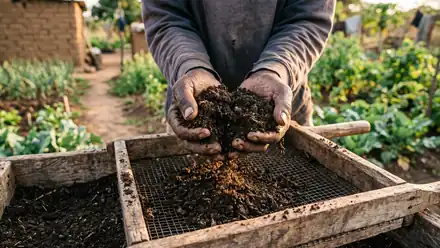
- 1–2 litres of mature, finished compost (sieved if possible)
- An old muslin cloth, nylon stocking, or fine mesh bag
- 15–18 litres of water (rainwater is best; if using borehole water, let it sit overnight)
- Optional: aquarium air pump with tubing and airstone for aerated method
Method
- Fill your bucket with water and let it settle for a few hours if using chlorinated town supply (chlorine inhibits microbial activity).
- Place compost in the cloth bag and tie it closed.
- Submerge the bag in the water — the ratio is roughly 1:10 to 1:20 (compost to water by volume) (Rodale Institute).
- Steep for 24–48 hours, stirring every few hours if not aerating.
- If aerating, run the pump continuously for 1–3 days. The water should be visibly bubbling.
- Remove the bag and set the spent compost aside (apply it directly to a bed).
- Dilute before applying — see rates below.
- Apply the same day you brew, particularly if aerated.
Dilution and application
Do not apply undiluted. A common working dilution is 1:5 to 1:10 (one part tea to five to ten parts water) for soil drenching and irrigation. For foliar spray (leaves), dilute further to 1:20 and apply only to healthy tissue in the early morning so leaves dry before midday heat.
Application timing:
- Seedlings: drench the soil at transplanting
- Actively growing crops: apply as a soil drench every 2–4 weeks
- Foliar: once per month on leafy vegetables, applied early morning, with at least 2 weeks between last application and harvest
Do not spray any liquid manure or compost tea on the edible parts of crops within 2 weeks of harvest. For root crops (carrots, beetroot, potatoes), do not apply at all from 4 weeks before harvest.
Liquid manure and comfrey tea in Zimbabwe
Two other common liquid feeds are worth a mention:
Manure slurry
Fresh cattle or goat manure diluted in water (approximately 1 kg to 10 litres) and left to steep for 5–7 days, stirred daily, produces a smelly but nutrient-rich liquid. It is high in ammonia-form nitrogen, which is rapidly plant-available but also volatile. Apply it to the soil, not leaves, and immediately water it in. The pathogen cautions above apply fully — keep it away from edible leaf crops close to harvest, and never use pig or poultry slurry on vegetables without proper composting first.
Comfrey tea
Comfrey (Symphytum officinale) leaves are exceptionally rich in potassium, nitrogen, and calcium. Pack leaves into a container, weigh them down with a stone, and leave covered for 3–4 weeks. The resulting dark liquid should be diluted 1:20 to 1:30 before use. It is a useful potassium source for fruiting crops (tomatoes, peppers, cucumbers) and is safe — no pathogen risk from plant-only inputs. If you have comfrey growing on your farm, this is worth making.
When solid compost is the better choice
| Situation | What to use |
|---|---|
| Rebuilding genuinely depleted soil | Solid compost worked into the ground (FAO Bulletin 56) |
| Correcting low organic matter over a season | Solid compost — liquid teas do not build humus |
| Quick nutrient top-up on actively growing crop | Compost tea / liquid feed |
| Seedling establishment | Compost tea as a soil drench at transplanting |
| You have limited compost and a large area | Compost tea to spread the biology further |
| Foliar disease treatment | See an agronomist — compost tea is not proven for this |
Liquid feeds are a supplement to soil compost, not a replacement for it. A soil that is low in organic matter cannot be fixed by liquid applications — the physical structure, water-holding capacity, and long-term fertility all depend on solid organic matter (Virginia Tech Extension; FAO How to Make and Use Compost).
That is the role of PCAT BLOCK C Organic Compost: it is the soil foundation — standardised, sieved, and field-proven — that fixes the underlying problem. Once your soil has good organic matter, liquid feeds become a useful seasonal tool on top of that base.
For how to use solid compost correctly, read how much compost per crop in Zimbabwe and using manure without burning your crop.
Frequently asked questions
Is compost tea safe to use on leafy vegetables like covo and rape? Yes, if made from mature compost (not fresh manure), diluted properly, and applied as a soil drench rather than a foliar spray during the final two weeks before harvest. Apply early in the morning if spraying leaves so they dry completely before midday. See growing leafy greens — covo, rape, spinach in Zimbabwe for full nutrition guidance on these crops.
How do I know if my compost is mature enough to use for tea? Mature compost is dark brown to black, crumbly, smells of clean earth, and shows no recognisable original materials. If it still smells of ammonia or shows visible manure, it is not ready. Immature compost tea can contain elevated ammonia and pathogens. When in doubt, wait another month.
Does compost tea replace fertiliser? No. Compost tea provides dilute, variable amounts of soluble nutrients and biology. It cannot substitute for a balanced nutrition programme when crops have specific deficiency symptoms. Think of it as a soil conditioner and microbial inoculant, not a precision fertiliser.
Can I use worm bin leachate as compost tea? The liquid that drains from a worm bin (leachate) contains some nutrients but also potentially contains pathogens from incompletely processed material. Dilute it heavily — at least 1:10 — and apply only to the soil, not to edible leaf surfaces. It is not the same as worm castings or finished vermicompost. See our vermicomposting guide for the difference.
How long will brewed compost tea keep? Not long. Apply it the same day it is brewed for best results, and certainly within 24 hours. Once brewed, the microbial population changes rapidly; aerated teas are particularly time-sensitive as oxygen levels drop and anaerobic conditions develop.
My compost tea smells terrible. Is something wrong? A foul, sulphurous, or sewage smell means the batch has gone anaerobic — usually from too little aeration, too warm temperatures, or too long a brew time. Discard it or apply it only as a soil drench away from edible leaf crops. Good compost tea should smell earthy and slightly sweet.
Do this now
- Make or buy mature compost first — liquid feeds are only as good as the compost they come from.
- Use only well-finished compost (dark, crumbly, earthy smell) — never fresh manure for foliar application.
- Keep it simple — a cloth bag, a bucket, and 24–48 hours of steeping works.
- Dilute before use — 1:10 for soil drenching, 1:20 for foliar spray.
- Apply the same day — do not store brewed tea.
- Never spray on edible leaves within 2 weeks of harvest — safety is non-negotiable.
- Do not expect it to fix depleted soil — that is solid compost’s job.
- Use as a supplement on top of good soil management, not instead of it.
PCAT BLOCK C Organic Compost — the locally-made, field-proven compost that builds the soil foundation your crops need. US$20 per 50 L bag. Ask us about rates.
Related: make your own compost from farm waste · use manure without burning your crop · read your soil before you spend
- Rodale Institute — Compost Tea: A How-To Guide
- FAO — How to Make and Use Compost (Climate Change and Food Systems Resilience in Sub-Saharan Africa)
- FAO Soils Bulletin 56 — Soil Management: Compost Production and Use in Tropical and Subtropical Environments
- FAO — On-farm composting methods
- Virginia Tech Extension — Compost: What Is It and What's It To You (452-231)
Join our free mailing list and we'll send the full 2026/27 calendar plus weekly seasonal tips.