Farming through drought in Zimbabwe: what actually works
A practical, evidence-led guide to climate-smart agriculture Zimbabwe farmers can use today — catch water, build organic matter, choose the right crops, and stack the odds before the rains fail again.
The question is not “how do I practise climate-smart agriculture?” Nobody who is staring at a cracked field in August asks that. The real question is simpler: how do I get a crop through a season where the rains arrive late, stop early, and take a two-week break in January?
That is what this article is about. Not vocabulary. Not policy frameworks. Practical technique, stacked in the right order, grounded in evidence from Zimbabwe and cited at every number.
One honest starting point: no technique drought-proofs a farm. If Natural Region IV gets 280 mm in a season — half its average — you are managing a disaster, not preventing one. What the techniques below do is improve your odds significantly. A farm that catches water, holds it in organic soil, and plants on an effective rain will outperform a conventionally-managed farm in the same bad season. That is the goal: stack the odds.
The problem in numbers
Zimbabwe’s rainfall is not just low — it is erratic. The country is divided into five natural regions based on rainfall:
- Natural Region I (Eastern Highlands): >1 000 mm/year — reliable, suited to most crops
- Natural Region II (highveld corridor, including Mashonaland): 750–1 000 mm/year — the maize belt, but vulnerable to mid-season dry spells
- Natural Region III (semi-extensive farming zone): 500–750 mm/year — marginal for maize without good practice
- Natural Region IV (semi-arid): 450–600 mm/year — sorghum and millet territory
- Natural Region V (dry lowveld): <450 mm/year — extensive ranching
(FAO, Fertilizer use by crop in Zimbabwe)
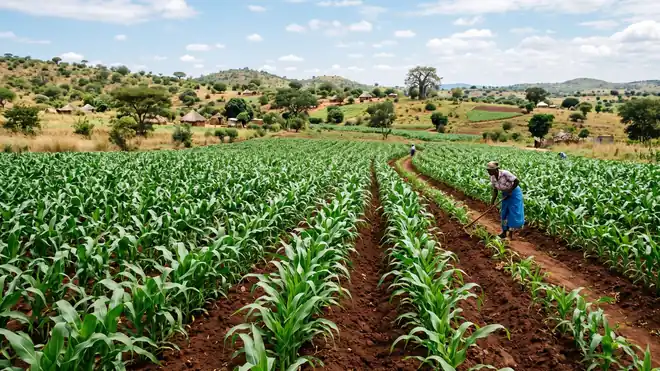
Most smallholder maize farming happens in Regions II and III — exactly where rainfall variability bites hardest. In a good year, Region II gets 850 mm. In 2024, the El Niño-driven drought pushed rainfall far below average across southern Africa, cutting harvests and triggering food security warnings across Zimbabwe. Sandy, granite-derived soils — which cover much of the highveld and communal farming areas — compound the problem: they drain fast and hold little water. Organic carbon levels in these soils are typically low after decades of residue removal and burning, reducing their capacity to retain both moisture and nutrients.
This is the land most Zimbabwean farmers are working with. The question is what to do about it.
Techniques that genuinely help: at a glance
Before the detail, here is the full picture in one place. Every technique below is elaborated in its own section or linked article.
| Technique | What it does | Cost / effort | When to do it |
|---|---|---|---|
| Planting basins (Pfumvudza/Intwasa) | Catches and concentrates rainfall at the plant | Low cost; moderate digging labour | August–October (dry season) |
| Tied ridges / water-harvesting bays | Traps runoff across the field; fills from upslope catchment | Low–moderate; planning required | August–October |
| Compost in the planting station | Creates a moisture reservoir at the root zone; humus holds up to 6 litres of water per kilogram | Cost of compost; moderate labour | August–October, before rains |
| Mulching | Cuts evaporation by up to 30%; shields soil from crusting | Low cost (crop residue); some gathering effort | Gather August–September; lay at planting |
| Plant on effective rain, not calendar date | Avoids seedling loss to false early rains | Zero cost; requires discipline and information | November–December |
| Shorter-season / drought-tolerant varieties | Escapes mid-season dry spell at critical growth stages | Seed cost varies | Plan and source in August–September |
| Spot / precision watering | Applies water at the root, not across bare soil | Low–moderate; drum drip kits start cheap | Year-round for gardens; dry-season for supplemental |
| Conservation agriculture (zero/minimum till) | Preserves soil structure and residue; reduces evaporation | Transition cost; sustained discipline | System-wide; plan this dry season |
Catch and hold the water that does fall
The first and most powerful thing you can do is stop water leaving your field. Zimbabwe’s rains arrive in intense bursts on soil that, if bare and capped, sheds them as runoff rather than absorbing them.
Planting basins — the core technique of Zimbabwe’s Pfumvudza/Intwasa programme — intercept that runoff at every plant position. A basin roughly 15 cm deep and 15 cm wide, dug on a grid before the rains, collects water and holds it at the root. FAO-supported Pfumvudza pilots have recorded some farmers reaching up to 7.8 tonnes of maize per hectare under strict management — a dramatic contrast to the sub-2 t/ha that most smallholders achieve on conventionally-managed fields (FAO Zimbabwe). See Pfumvudza and rainwater harvesting for full basin dimensions and the rainwater-harvesting layout.
Tied ridges close off the ends of conventional ridges at intervals, turning what would be a drainage channel into a series of small water-retention bays. Water that would run to the edge of your field now soaks in. The principle is the same as the basin: intercept water at the surface before it becomes runoff.
Water-harvesting bays operate at a slightly larger scale — a slightly depressed area at the top of the plot that collects rainfall and runoff from an upslope catchment area, funnelling it slowly into the cropped zone. These are described in the original SCIT launch as a component of the full system, though they require more planning and earthwork.
The single investment that makes all of these work harder: dig in the dry season. August soil is workable. November soil — when the first rains are arriving — is either bone-hard or waterlogged. A family that spends August digging can plant within a day of the first effective rain. One that starts in November is already behind.
This is the dry season. It is the right time to do this work. See preparing your land before the rains for the full August–October checklist.
Build organic matter so your soil holds the water it catches
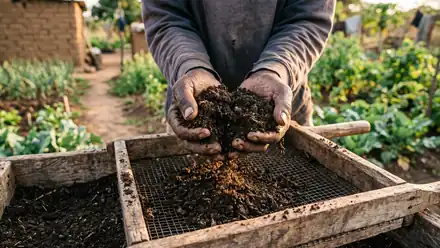
Catching water is only half the equation. Sandy soils — roughly 0.2 litres of water held per kilogram of soil — drain fast. Organic matter changes that. Humus, the stable dark fraction of well-made compost, holds up to 6 litres of water per kilogram — thirty times more than the sandy soil it replaces (FAO). Add compost to your planting station and you are not just fertilising — you are inserting a moisture reservoir directly below the root zone.
This is the principle behind compost-based farming in drought conditions. It takes more than one season: organic matter accumulates, soil structure improves, and each year’s application builds on the last. But the compounding effect is real: soils with sustained organic inputs hold moisture measurably longer into a dry spell than unamended sandy soils (FAO Conservation Agriculture Zimbabwe).
Application: put compost in the planting station, not broadcast across bare inter-row ground. Station application concentrates the moisture-holding capacity where the roots are. For on-farm production of compost, see making compost from farm waste. For ready-made, locally produced compost, PCAT BLOCK C Organic Compost is available at US$20 per 50L bag — message us with your crop and station count for a tailored rate. See compost in the planting station for full method and per-station mixing guidance, and how much compost per crop in Zimbabwe for broadcast rates.
We publish no invented compost rates. Per-station volumes depend on your crop, station size, and baseline soil condition. Message us with those details and we will advise a conservative starting rate.
Mulch: keep what the rain put in the ground
Mulch is the cheapest tool on this list and arguably the most underused. A 5–10 cm layer of dry grass or crop residue over the soil surface cuts evaporation dramatically. Research from semi-arid Zimbabwe shows mulched plots retaining 15–32% more soil water than bare plots by reducing evaporation and improving infiltration (MDPI Agriculture, 2022). That moisture gap is the difference between a crop that makes it through a fortnight-long January dry spell and one that does not.
The practical rule: stop burning crop residue. Spread your maize stover across the field. Gather dry grass from roadsides and headlands in August and September, before it becomes too brittle. Lay it over your basins after planting and keep the surface covered.
One honest caveat: mulch also holds moisture for weeds. Stay on top of weeding, especially in the early weeks after the rains begin.
See mulching to beat dry spells for materials, application depth, and how mulch and compost work together.
Plant on an effective rain, not a calendar date
This rule is worth stating clearly because breaking it is one of the most common and costliest mistakes in Zimbabwean farming. The first showers in October and early November are almost always false rains — a week of heat follows, the germinated seed dries in the ground, and you lose both seed and time.
An effective rain means at least 20 mm over about three days, with no extended dry spell expected in the following ten days. The Meteorological Services Department consistently warns against planting on early showers (The Herald / MSD). Wait. Use early October showers for a final harrowing to prepare your seedbed. Then plant the day the effective rain arrives — not the week after.
Every week of delayed planting past the optimal window costs yield. A crop that was in the ground by 15 November will consistently outperform the same variety planted on 1 December (Seed Co Agronomy Manual). Basins dug in the dry season mean you can plant the same day the rain comes. Basins dug in November mean you are digging while the rain falls.
Choose crops and varieties that match your rainfall
In Natural Regions III and IV, chasing a full-season maize hybrid is a gamble most years. Shorter-season maize varieties — 90-day cultivars rather than 120-day ones — mature before the late-season moisture stress period that consistently cuts yield in semi-arid areas. Seed Co’s 90-day varieties are bred specifically for Zimbabwe’s drier zones (Seed Co Agronomy Manual).
Sorghum and small grains are the honest choice for regions where rainfall is persistently below 600 mm. Sorghum has deeper roots, closes its stomata during water stress, and resumes growth when rain returns — responses that maize does not have. See sorghum and small grains for dry regions for variety selection and agronomy.
Legumes in rotation — cowpeas, groundnuts, sugar beans — fix nitrogen while managing water more efficiently than maize, and provide a food-security backstop in a bad rain year. See legume rotations for free nitrogen.
Spot watering and precision irrigation
Where you have access to water — a borehole, a tank, a hand pump — the question is not whether to irrigate but where. Surface or furrow irrigation loses a large fraction of what is applied to evaporation, runoff, and deep drainage before it reaches the root zone; FAO estimates surface systems operate at 40–60% efficiency (FAO water-use efficiency). Watering the whole field wastes what you cannot afford to waste.
Spot or precision watering directs that same water to the plant position only — ideally into a compost-filled station where organic matter holds the application between waterings. A simple bucket and a watering can applied at the station is more efficient than a sprinkler on a bare field.
Drip irrigation takes this further: 70–90% efficiency, delivered at the root. A drum kit — a raised tank feeding thin lines to vegetable beds — is low-cost and teachable in an afternoon. See drip irrigation on a budget for how to start cheaply and scale. For market-garden situations where water is scarcer, SCIT spot irrigation applies the same precision principle at the planting-station scale.
A Zimbabwean worked example: what SCIT showed is possible
In July 2019, PCAT engineer and HIT lead researcher Joseph Ngirande launched SCIT — Scientific Conservation Irrigation Technology — at Domboshava, following eight years of development. PCAT, in collaboration with HIT, piloted the system in Chirumanzu (The Herald, Sallomy Matare, republished by CFU Zimbabwe).
The principle: compost-filled moisture-conservation potholes dug at each plant position, applying 1 litre of water per station per week. The organic fill absorbs and slowly releases that water through the week — a precision reservoir at the root zone. The system operates under zero tillage, and HIT’s EMRECC research programme describes SCIT as involving “zero tillage, vermi-ferts, and thermal compost, mulch and conservation pots” (HIT EMRECC).
The reported yield from Chirumanzu: 18 tonnes of maize per hectare, on experimental plots, under research conditions (The Herald / CFU Zimbabwe). We state the full context every time we cite that number: this is a controlled-trial result, not a typical farmer yield. Zimbabwe’s Pfumvudza programme, with strong FAO and government support, has recorded up to 7.8 t/ha under strict management — itself exceptional. The 18 t/ha figure is a data point about what the integrated system achieved under controlled conditions; it is not a promise.
What SCIT demonstrates for the broader drought question is the principle: concentrate water and organic matter exactly at the root, leave the space between plants undisturbed, and the total water requirement drops dramatically while the plant’s access to moisture rises. Any farmer with a shovel, compost, and a 20-litre container can apply this principle whether or not the full commercialised system is available.
HIT is a research and technology institution whose role is to develop and validate these systems. EMRECC’s published work spans environmental management, waste, energy, and water; agriculture is a downstream application of that research. Neither HIT nor EMRECC is a seller or commercial endorser of any product.
See the full explanation, including commercialisation status and what you can do today without the complete system, in SCIT spot irrigation Zimbabwe.
How climate-smart agriculture Zimbabwe actually works — the H2 that matters
“Climate-smart agriculture” is a UN policy term for farming that improves productivity, builds resilience to climate shocks, and where possible reduces emissions. The NGO version of this phrase fills reports. The farmer version is the stack of techniques described above, applied in the right order.
Here is that order for how to farm in drought Zimbabwe:
- Test your soil. Before you spend anything. See read your soil before you spend.
- Dig basins or potholes in the dry season — before the land is either too hard or too wet.
- Fill stations with compost — the moisture-holding engine that makes 1 litre of water do the work of five.
- Mulch everything — stop the rain that did fall from evaporating before the roots get it.
- Plant on effective rain — not the first shower.
- Choose the right crop for your natural region — sorghum and small grains in Regions IV and V, short-season maize or drought-tolerant hybrids in Region III.
- Water precisely — at the root, in small quantities, regularly — not across the field.
- Repeat every season — organic matter compounds; the soil that survived drought this year handles next year’s dry spell better.
None of this drought-proofs a failed season. A year with 40% of normal rainfall will always be hard. But a farm with mulched, compost-rich planting stations that was planted on time will produce something where a bare, late-planted field produces almost nothing. That is the honest case for drought-tolerant farming Zimbabwe-style — not a guarantee, but a systematic improvement in odds.
What to do this season: August to November
It is now August, the middle of the dry season. The rains will begin in earnest around November. Here is what the next three months look like as a plan:
August (now)
- Book a soil test and start acting on results — lime takes weeks to react (read your soil before you spend)
- Begin digging Pfumvudza basins or planting potholes — dry soil is workable
- Apply compost to basins and any fields you are preparing — 4–6 weeks before planting for maximum benefit
- Start or maintain a compost pile from crop waste: making compost from farm waste
- Order PCAT BLOCK C now if you are short on homemade compost
September
- Continue basin digging; complete before the soil becomes too hard late in the month
- Gather mulch — dry grass, stover — and stockpile near the fields
- Source seed: match variety maturity to your natural region and historical dry-spell timing
- Source your legume rotation seed before October demand peaks
October
- Lay mulch over basins and between rows; it should be in place before the first rains
- Final harrowing to prepare seedbed (use early showers for this, not for planting)
- Check all tools, irrigation kit, fertiliser — everything must be on hand before November
- Monitor MSD seasonal forecasts; note the expected onset date for your region
November–December (planting)
- Wait for the effective rain: at least 20 mm over about three days, no extended dry spell forecast (The Herald / MSD)
- Plant the day the effective rain arrives — basins already dug, seed already sourced
- Apply basal fertiliser in the station at planting; topdress at first node
For the full month-by-month breakdown, see preparing your land before the rains and the 2026/27 planting calendar.
Frequently asked questions
What does “effective rain” mean and how do I know when it has arrived? An effective rain is generally at least 20 mm falling over about three days, with no prolonged dry spell in the following ten days. The Meteorological Services Department issues seasonal and short-range forecasts — check these regularly in October and November (The Herald / MSD). The October showers that excite everyone in a hot, dry year are almost never effective rains. Use them for harrowing; keep seed dry.
Is there a drought-tolerant maize variety I should plant in Zimbabwe? Short-season hybrids (90 days) from Seed Co and other breeders are bred for drier conditions and escape late-season dry spells by maturing earlier (Seed Co Agronomy Manual). In Natural Regions III and IV, sorghum is a more reliable bet than any maize hybrid in a below-average rainfall year — see sorghum and small grains for dry regions.
How much water does compost actually save? The key number: humus in well-made compost holds up to 6 litres of water per kilogram, compared to roughly 0.2 litres per kilogram for typical sandy Zimbabwean soil (FAO). That is why compost in the planting station acts as a reservoir — and why the SCIT trial could sustain maize on 1 litre per pothole per week. The benefit builds over seasons as organic matter accumulates. Mulch adds to this: mulched plots hold 15–32% more soil water than bare soil (MDPI Agriculture, 2022).
Can water-harvesting bays or tied ridges work on a small plot? Yes. The principle scales down well. A tied ridge on a 0.1 ha homestead plot works exactly as it does on a field — it stops water running off bare soil and keeps it where the crop can use it. Pfumvudza basins are specifically designed for small, intensively managed plots (FAO Zimbabwe). See Pfumvudza and rainwater harvesting.
Will these techniques work in Natural Region IV and V where rainfall is very low? They improve outcomes, but they cannot create water that is not there. In Region IV (450–600 mm), the combination of planting basins, compost, mulch, short-season or drought-tolerant varieties, and spot watering can sustain a productive smallholder plot in a typical year. In Region V (<450 mm), extensive livestock or drought-resilient small grains like sorghum and pearl millet are more realistic than maize. The techniques in this article reduce water loss and improve moisture availability at the root — they do not replace rainfall.
What is the honest position on the 18 t/ha SCIT maize figure? It is a result from experimental plots under research conditions in Chirumanzu, reported at the 2019 SCIT launch by Joseph Ngirande of PCAT/HIT (The Herald / CFU Zimbabwe). It is not a typical or guaranteed farmer yield. For context: FAO-supported Pfumvudza pilots achieved up to 7.8 t/ha under strict management (FAO Zimbabwe); Zimbabwe’s smallholder average is well below 2 t/ha. The 18 t/ha figure tells you what the integrated system achieved under controlled conditions with precise management. It is not a sales claim.
Do this now
- Test your soil this week — before you spend on any input. Knowing your pH and organic matter status changes what you buy and how much. Start at read your soil before you spend.
- Dig basins or potholes this month — dry August soil is far easier to work than wet November soil.
- Apply compost to your stations now — it needs 4–6 weeks to integrate before planting. PCAT BLOCK C is fully processed and ready to go in. Message us with your crop and land size.
- Gather mulch in August–September — stockpile it near the field, ready to lay at planting.
- Source your seed early — short-season varieties for your natural region, legume rotation seed before October.
- Read the MSD seasonal forecast — know your expected onset date before you commit to a planting date.
- Plant the day the effective rain arrives — not before.
PCAT BLOCK C Organic Compost — PCAT’s locally-made compost, available now at US$20 per 50L bag. Put it in your planting stations this dry season, before the rains, and let organic matter do the water-holding work that makes every other technique on this list work harder.
Related: Pfumvudza and rainwater harvesting · mulching to beat dry spells · drip irrigation on a budget · compost in the planting station · SCIT spot irrigation Zimbabwe · sorghum and small grains for dry regions · preparing your land before the rains · read your soil before you spend · maize planting calendar Zimbabwe
- FAO — Conservation Agriculture on a roll in Zimbabwe (Pfumvudza practices and yields)
- FAO — How to make and use compost: Sub-Saharan Africa guide (humus water-holding capacity)
- FAO — Conservation Agriculture and sustainable crop intensification: a Zimbabwe case study
- FAO — Fertilizer use by crop in Zimbabwe (natural region recommendations)
- The Herald (Sallomy Matare), republished by CFU Zimbabwe — HIT launches new irrigation system, July 2019
- HIT EMRECC — Research projects including SCIT (zero tillage, vermi-ferts, thermal compost, conservation pots)
- Conservation Agriculture in semi-arid Zimbabwe (MDPI Agriculture, 2022) — soil-water gains from mulch
- Seed Co Zimbabwe — Agronomy Manual (conservation tillage, planting timing, effective rain rule)
- The Herald / Meteorological Services Department — effective rain planting rule
Join our free mailing list and we'll send the full 2026/27 calendar plus weekly seasonal tips.