Export-quality peppers start with the soil
Export quality peppers Zimbabwe: grading and uniformity rules explained, why stressed plants fail them, and how moisture-buffered, organic-rich soil is the real route to a crop that grades well.
No compost bag on earth can certify your peppers for export, and we’re not going to pretend otherwise. What organic-rich soil genuinely does is make your crop more even — steadier size, steadier colour, fewer stressed, blemished fruit — and evenness is exactly what buyers are grading for. If chilli and pepper contracts have caught your attention (see Zimbabwe’s chilli export boom), this is the honest, unglamorous groundwork behind it.
New to peppers and chillies? Start with our full growing peppers and chillies in Zimbabwe guide and pepper pests and diseases.
What “grading” actually means
Before you can hit an export standard, you need to know what one looks like. Grading schemes for sweet peppers — used as reference points by exporters and buyers worldwide — classify fruit into tiers such as “Extra,” Class I and Class II, each defined by defects, shape, colour and, critically, uniformity (CARICOM CRS 24-9). The US grading standard is just as explicit: top grades must be “free from sunscald… and from injury caused by scars, hail, sunburn, disease, insects, mechanical or other means,” with strict minimum size rules and a requirement that at least 90% of fruit in a lot show the specified colour to qualify for that grade at all (USDA AMS).
Read that again: it’s not about any single perfect pepper. It’s about the whole lot being consistent — size, colour and condition matching across the batch. A grader isn’t hunting for your best fruit; they’re checking whether your worst fruit is still good enough, and how much of your harvest falls into that category.
Straight talk on compost and certification: organic compost does not certify export quality, and we make no claim that it does. There is no residue test or stamp a bag of compost confers. What it can do — and what the rest of this article covers — is reduce the plant stress that causes the specific defects graders reject for.
Why stressed plants grade poorly
This is the part that actually matters for your bottom line: the defects that get fruit downgraded or rejected are, overwhelmingly, stress responses — not random bad luck.
Blossom-end rot is the clearest example. It’s a physiological disorder, not a disease, caused by a localised calcium shortage in the fruit — driven far more often by uneven water uptake than a true lack of soil calcium. Calcium only moves through the plant dissolved in water; if watering is inconsistent — a dry week followed by a soak, or soil that can’t hold moisture between waterings — delivery to the fastest-growing fruit gets interrupted and dark, sunken rot appears at the blossom end (Rutgers NJAES). Rutgers’ guidance is blunt about the fix: maintain even soil moisture and correct soil pH — no spray reliably reverses it once it starts.
Sunscald is a second, separate defect with a similar root cause: plant stress leaves fruit exposed. It happens when shaded fruit suddenly finds itself in direct, intense sun — and New Mexico State University Extension notes that defoliation or prolonged wilting from other stress and disease pressure is a direct contributor, stripping away the leaf cover that would otherwise shade the fruit (NMSU). A vigorous, well-fed, unstressed plant keeps its canopy — and its canopy protects the fruit beneath it.
The pattern across both defects is the same: an evenly fed, evenly watered plant produces fewer downgraded fruit. That’s not a marketing line — it’s the physiology behind two of the most common rejection causes for peppers and chillies anywhere in the world.
Where moisture buffering and steady feeding come in
This is the legitimate, honest link between your soil and your grading rate — worth being precise about what it is and isn’t.
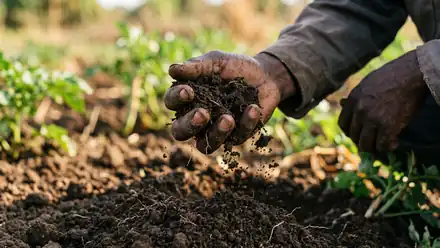
Organic matter in soil acts as a buffer, not a tap. Well-decomposed organic material holds far more water against a plant’s roots than mineral soil alone, releasing it steadily rather than letting the field swing between waterlogged and bone-dry — the same swing that interrupts calcium delivery and triggers blossom-end rot. FAO’s guidance on compost use puts a figure on it: the humus in well-made compost can hold up to 6 litres of water per kilogram (FAO) — a meaningful buffer against exactly the dry-spell-then-downpour pattern that causes uneven fruit.
Nutrient release works the same way. Unlike a dose of mineral fertiliser that’s available immediately then gone, organic matter breaks down gradually, feeding the crop over weeks rather than one spike — though this depends on your soil’s starting organic-matter level, which is why FAO’s compost guidance stresses nutrient content isn’t standardised the way a bag of urea is (FAO Soils Bulletin 56). Compost feeds more evenly than an unfed, mineral-only field would — the entire point when the goal is consistency, not a single yield spike. See how much compost per crop in Zimbabwe for cited application rates.
| What causes the defect | What actually drives it | Where soil comes in |
|---|---|---|
| Blossom-end rot | Uneven water uptake interrupts calcium delivery to fruit (Rutgers) | Moisture-buffered soil evens out the wet/dry swings that trigger it |
| Sunscald | Fruit loses leaf shade after stress-related defoliation or wilting (NMSU) | A well-fed, unstressed plant keeps a fuller canopy shading its fruit |
| Failing uniformity checks | Some plants outgrow others under patchy fertility or moisture | Steady feeding narrows the spread between best and worst plants |
| Rejected on defect tolerance | A minority of stressed plants can sink an entire graded lot | Fewer stressed plants means fewer rejects dragging the average down |
Mulch on top, buffer underneath
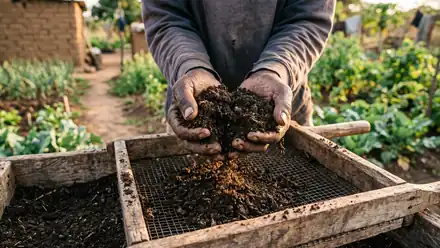
Moisture buffering works best as two complementary layers. Compost worked into the soil builds the organic matter that holds and steadily releases water at the root zone; mulch spread on the surface stops that moisture evaporating and keeps topsoil temperature steadier through the heat of the day. We cover mulch’s water-saving numbers in mulching to beat dry spells — the two are not alternatives, they’re a stack: compost holds the water, mulch stops it leaving.
Records: the part buyers increasingly ask for
Consistency isn’t only proven in the field — increasingly, it’s proven on paper. Formal export and certification schemes (GlobalG.A.P.-style audits, for instance) require growers to keep documented input and production records an auditor can cross-check against the farm. Even without a full audit, more contract arrangements ask growers for a documented history of what went into the crop and when — a buyer committing to your entire harvest wants evidence you can repeat it next season, not just a good-looking sample today.
This is precisely why farm records that win a loan matters as much for a pepper exporter as a loan applicant: writing down what you planted, when you fed it, and how it performed is the same discipline a buyer’s audit will eventually ask to see.
Do this now
- Test your soil before the season starts — see read your soil before you spend. You can’t fix what you haven’t measured.
- Build organic matter into your beds, not just around them — PCAT BLOCK C worked into the soil gives roots a moisture and nutrient buffer, not a surface treatment.
- Mulch on top of that buffer to stop the moisture you’ve built from evaporating away — see mulching to beat dry spells.
- Water evenly, not just often. A consistent schedule matters more than a large but irregular one for avoiding blossom-end rot.
- Keep the canopy healthy — control disease and defoliation promptly so fruit stays shaded and sunscald risk stays low.
- Write it all down. Dates, quantities, applications — farm records that win a loan is the habit that turns a good crop into a repeatable, buyer-trusted one.
The honest bottom line
Nobody can sell you a bag of compost that guarantees an export contract, and we won’t try. What steady, organic-rich soil buys you is fewer stressed plants — and fewer stressed plants means fewer of the exact defects that graders are trained to catch. That’s a real, physiological, citable link between your soil and your price per kilogram. It’s just not a certificate, and it’s not overnight.
PCAT BLOCK C — the locally-made, field-proven compost that rebuilds Zimbabwe’s tired, acidic soils, buffering moisture and feeding crops steadily for the even, well-graded harvest buyers actually pay for.
Related: growing peppers and chillies in Zimbabwe · pepper pests and diseases in Zimbabwe · Zimbabwe’s chilli export boom · how much compost per crop in Zimbabwe · mulching to beat dry spells
- Rutgers NJAES FS011 — Blossom-End Rot: Tomatoes, Peppers, Eggplant
- New Mexico State University H249 — Chile Pepper Disorders Caused by Environmental Stress (sunscald)
- USDA AMS — Sweet Peppers Grades and Standards
- CARICOM Regional Standard CRS 24-9 — Specification for grades of fresh agricultural produce: sweet peppers
- FAO Soils Bulletin 56 — Soil management: compost production and use in tropical and subtropical environments
- FAO — How to make and use compost (Sub-Saharan Africa guide)
Join our free mailing list and we'll send the full 2026/27 calendar plus weekly seasonal tips.