Tomato pests & diseases in Zimbabwe — the organic way
Tomato diseases in Zimbabwe explained — early/late blight, bacterial wilt, Tuta absoluta, red spider mite and whitefly — with organic, IPM-first control that protects your soil too.

Disease is what actually ends most tomato seasons in Zimbabwe — not price, not pests alone, but blight or wilt moving through a crop faster than anyone can react to it. The organic-first order of operations: prevent with airflow, sanitation and rotation; scout constantly; go cultural and biological before chemical; and reach for a spray — copper or otherwise — only once pressure genuinely demands it.
Growing the crop from scratch? Start with the full lifecycle guide: growing tomatoes in Zimbabwe.
At a glance
| Threat | Type | First response | Spray acceptable? |
|---|---|---|---|
| Early blight | Fungal | Rotation, remove lower leaves, avoid overhead water | Copper oxychloride if pressure is high (AgriUniverse) |
| Late blight | Fungal | Airflow, spacing, avoid wet foliage | Copper oxychloride if pressure is high (AgriUniverse) |
| Bacterial wilt | Bacterial | Pull & destroy; clean seed; rotate 3–4 seasons | No — no spray cure |
| Damping-off | Soil-borne fungal | Seed treatment; avoid wet, humid seedbeds | Fungicide drench as a targeted last resort (AgriUniverse) |
| Tuta absoluta (leafminer) | Invasive insect | Scout for mines/tunnelling; remove affected leaves; pheromone trapping | Targeted biological/IPM control preferred |
| Red spider mite | Sap-sucking mite | Scout leaf undersides; keep plants unstressed | Only if infestation is heavy (AgriUniverse) |
| Whitefly / aphids | Sap-sucking insects | Scout, remove debris, encourage natural enemies | Soapy water first; targeted spray if virus risk is high (AgriUniverse) |
Prevention beats every cure
Nearly everything on this list is held back by the same handful of habits, and they cost nothing beyond labour:
- Airflow first. Stake every plant and hold to full spacing — damp, still air in a crowded canopy is exactly what blight needs (AgriUniverse). Under a tunnel, keep this up with disciplined leaf removal — no more than two lower leaves at a time, fortnightly, keeping at least 1.5 m of healthy leaf on the plant to guard against Botrytis (Seed Co).
- Water at the base, never overhead — avoiding overhead irrigation is a named control for early blight (AgriUniverse). See drip irrigation on a budget.
- Rotate. Tomatoes on the same ground more than once a year is directly linked to early blight (AgriUniverse); for wilt, rotate 3–4 seasons away from tomato-family crops.
- Use certified, clean seed, and strip diseased lower leaves immediately on sight (AgriUniverse).
- Sanitise between crops — under cover especially, disinfecting structures and containers between plantings guards against carrying virus into the next crop (Seed Co).
Early and late blight
Both fungal, both favoured by hot, humid conditions, both spread by wind-blown spores (AgriUniverse). Late blight shows as greasy, grey-green patches that brown and can blacken and kill a plant within days once conditions favour it. Early blight starts as dark brown, irregular spots on the oldest leaves, developing concentric rings with a yellow halo as they mature (AgriUniverse).
Organic-first: avoid overhead water, remove lower leaves promptly, keep full spacing, rotate off the ground. Where copper is acceptable: if pressure is genuinely high despite good practice, copper oxychloride is named as an accepted control for both blights in Zimbabwean guidance (AgriUniverse) — a later-line tool once prevention is already in place, not a routine substitute for it.
Bacterial wilt
Sudden wilting with no obvious cause, sometimes with slimy ooze from a cut stem. There is no spray cure. Pull and destroy infected plants immediately, use certified clean seed, rotate 3–4 seasons away from tomato-family crops, and don’t over-apply nitrogen — lush, soft growth is more vulnerable, not less.
Tuta absoluta (tomato leafminer)
Tuta absoluta — recently reclassified as Phthorimaea absoluta — is a comparatively newer, invasive moth pest that has spread widely across Africa. Larvae mine into leaves, stems and fruit, and CABI’s international pest databases list it among the significant invasive threats to tomato that growers should actively monitor for (CABI PlantwisePlus); Zimbabwean guidance covers it within the general run of leaf-mining and boring pests needing active scouting rather than routine spraying (AgriUniverse).
Look for: silvery mine trails or blister-like patches on leaves, small entry holes on green fruit. Organic-first: scout younger leaves regularly and remove/destroy mined ones before larvae mature; use pheromone traps to monitor moth activity; clear crop debris and volunteer nightshade-family plants that host the pest between seasons; reserve targeted insecticide for genuinely heavy, escalating infestation.
Red spider mite, whitefly and aphids
Red spider mite sucks sap, leaving tiny mottled, silvery leaves with fine webbing and red dots on the underside — look there first, since affected plants stay small and unwell (AgriUniverse). Mites build up fastest on stressed, drought-hit plants, so even watering is itself a control; where an outbreak is established, burning infested leaves and plants is a named control alongside spraying (AgriUniverse).
Whitefly and aphids suck sap and — more seriously — transmit virus diseases, so their real danger is often what they carry rather than direct feeding damage (AgriUniverse). Scout regularly, clear debris where they shelter, encourage natural predators, and try soapy water — named as an accepted first-line option — before anything stronger (AgriUniverse).
Damping-off (seedlings)
Young seedlings pinched at soil level, then collapsing and dying, point to damping-off — soil-borne, favoured by continuously humid conditions at the soil surface (AgriUniverse). Prevent it with treated seed, well-drained seedbeds, and — critically — no nitrogen fertiliser once seedlings have their first true leaves (AgriUniverse). Full method: raising strong vegetable seedlings.
Healthy soil is your first line of defence
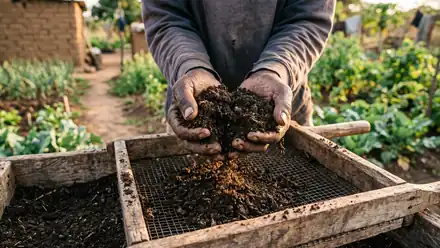
Every threat above hits a stressed, poorly-fed plant harder than a vigorous one. A tomato in living, organic-matter-rich soil resists disease pressure and shrugs off pest damage far better than one struggling in tired, acidic, exhausted ground — the same principle behind beating fall armyworm organically in maize. Building that soil with PCAT BLOCK C Organic Compost isn’t a pest treatment in itself — it’s the foundation that makes every scouting habit and every targeted spray work harder. Start from read your soil before you spend if you haven’t tested yet.
Frequently asked questions
Is copper spray organic, and when should I use it? Copper oxychloride is widely accepted in organic/IPM systems as a targeted, later-line tool for blight, named as an accepted control when pressure is genuinely high (AgriUniverse). Airflow, spacing and base-watering come first; copper is for when those aren’t holding the line.
What’s the first sign of bacterial wilt, and can I save the plant? Sudden whole-plant wilting, sometimes with slimy ooze from a cut stem, with no drought cause. There’s no spray cure — pull and destroy the plant immediately to protect the rest of the crop.
How do I tell blight apart from a nutrient problem? Blight shows as expanding, often concentric-ringed lesions, typically starting on older leaves and worsening fast in hot, humid weather (AgriUniverse). A nutrient deficiency tends to show as more uniform yellowing without lesions. If unsure, read your soil before you spend.
Is Tuta absoluta something I should actually be scouting for? Yes. It’s an invasive pest that has spread widely across the region and is tracked by international pest databases as a significant tomato threat (CABI PlantwisePlus). Check leaves and green fruit routinely rather than assuming it’s absent.
Should I spray preventively even before I see pests? No. The order is prevention (airflow, rotation, clean seed), then scouting, then targeted intervention only once a real threshold is reached. Routine preventive spraying costs money and kills the natural enemies that would otherwise help you.
Do this now
- Prevent first — airflow, base-watering, rotation, clean seed.
- Scout on a schedule — check leaf undersides and young fruit, not just when something looks wrong.
- Remove and destroy diseased leaves and infected plants immediately.
- Go cultural and biological before chemical — hand-removal, soapy water, sanitation, natural enemies.
- Reserve copper (and any spray) for genuine pressure, not as routine.
- Build healthy soil so the plant you’re protecting starts strong.
PCAT BLOCK C — the locally-made, field-proven compost that rebuilds Zimbabwe’s tired, acidic soils.
Related: growing tomatoes in Zimbabwe · beating fall armyworm organically · read your soil before you spend
Join our free mailing list and we'll send the full 2026/27 calendar plus weekly seasonal tips.