Sweet potatoes need feeding too: the 'scavenger crop' myth
Sweet potato farming in Zimbabwe suffers from one persistent myth — that the crop needs no fertility at all. Here's the cited evidence for why that costs you yield.
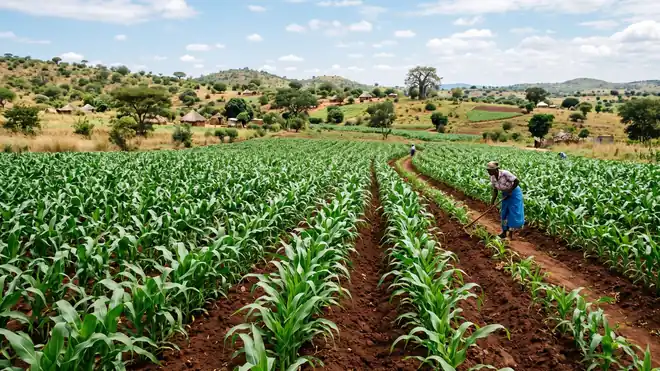
Ask a room of smallholder farmers what sweet potatoes need, and you’ll hear it again and again: nothing. Stick a cutting in the ground and walk away — it’s a “scavenger crop.” It’s one of the most repeated pieces of farming folklore in Zimbabwe, and it’s costing growers real yield. Here’s what the evidence actually says.
New to root crops generally? For the input-hungry cousin of this crop, see growing potatoes in Zimbabwe — sweet potatoes sit at the opposite end of the input spectrum, but “opposite end” doesn’t mean “zero.”
Sweet potato basics at a glance
| Stage | Target / spec | Source |
|---|---|---|
| Soil pH | 5.0–6.3 (lime below 5.0) | Agritex |
| Ridge/mound height x width | 20–45 cm high, 75–90 cm wide | Agritex; CFU |
| Cutting length / angle | 30–40 cm, planted at 45° | Agritex; CFU |
| Plant population target | ~30,000–40,000 cuttings/ha | Agritex; CFU |
| Fertility (myth-bust figure) | Compound D ~600–900 kg/ha + topdress at flowering | CFU |
| Weeding window | 4–8 weeks after planting | Agritex |
| Harvest | ~120 days (up to 240, cultivar-dependent) | Agritex |
| Average yield | ~19 t/ha; up to 50 t/ha with good management | Agritex |
The myth, and where it comes from
Sweet potatoes genuinely are forgiving. They tolerate marginal conditions — dry spells, poorer soils — and need fewer inputs and less labour than a crop like maize (CIP). That reputation is well earned, and it’s exactly why the crop is so popular with Zimbabwean smallholders as a “filler crop” planted after the main maize and soyabean window closes, and as a drought-resilient food-security option when the main season fails (CFU; CFU).
But “tolerates poor soil” quietly got rounded up to “needs no fertility at all” — and the evidence doesn’t back that. As one Zimbabwean farming advisory puts it directly: “Most farmers are used to growing sweet potatoes without fertiliser, believing that they are a scavenger crop. Sweet potatoes are actually heavy feeders and a fertilised crop will yield better than a non-fertilised crop” (CFU). Zimbabwe’s own Agritex extension handbook agrees without qualification, stating the crop “respond[s] well to organic manuring” and setting specific mineral fertiliser rates (Agritex) — not the treatment of a crop that needs nothing.
The honest version: sweet potatoes will survive on neglected soil in a way maize won’t. They will not yield well on it. Those are two different claims, and the myth conflates them.
Ridges, and vine cuttings done right
Sweet potatoes are planted on raised ridges or mounds, roughly 20–45 cm high and 75–90 cm wide (Agritex; CFU): the loose soil gives storage roots room to expand, the ridge prevents deformed tubers, harvest is easier, and building along the contour keeps water flowing evenly on sloped ground (CFU). Flat planting is technically possible (Agritex), but the yield and shape benefits of ridging make it the default everywhere we checked.
Propagate from vine cuttings taken off vigorously growing, disease-free stock (Agritex):
- Length and angle: 30–40 cm with 5–7 nodes, planted at roughly 45° with at least three nodes buried — more buried nodes means more potential root sites and better yield (Agritex; CFU). Terminal cuttings (growing-tip) yield highest (Agritex).
- Depth ~6 cm — deeper and cuttings struggle to sprout and are harder to harvest later (CFU).
- Plant fresh cuttings quickly — leaving them to sit for days before transplanting is a common, avoidable mistake (CFU).
- Population: roughly 30,000–40,000 cuttings/ha, 20–40 cm apart in-row (Agritex; CFU); replace dying plants in the first two weeks (CFU).
Time it with the rains. Plant at the onset of the rains for fastest establishment (CFU); without irrigation, and where rainfall is under 1,000 mm/year, planting early with the rains is specifically recommended (Agritex) — which is also why the crop slots so well as a February “filler” after the main planting window has passed (CFU). Vines are frost-tender and killed by winter frost, and the crop prefers 24–29°C with 750–1,000 mm of rain a year (Agritex).
Moderate fertility: feed the roots, not the vines
This is where the myth causes real damage, and where the fix needs a light touch. What the evidence supports: apply Compound D at roughly 600–900 kg/ha, plus a topdress of ~100 kg/ha of nitrogen at flowering on sandy soils especially (CFU) — Agritex’s own figures are broadly consistent, at roughly 60 kg N/ha split at planting and a month later, plus ~300 kg/ha Compound D, noting the crop “respond[s] well to organic manuring” (Agritex).
Where to hold back: excess nitrogen and excess water both push vine growth at the expense of root development — Agritex is explicit that overwatering late in the season “causes extensive vine growth at the expense of root development” (Agritex), and the same trade-off applies to nitrogen. Too much ammonium nitrate specifically harms flavour (CFU). Test rather than guess — the soundest advice is to have soils tested for a proper recommendation (CFU); see read your soil before you spend.
This is exactly why we frame PCAT BLOCK C Organic Compost as balanced fertility and structure, not a growth accelerant, for a crop like this. Compost builds the loose, organic-matter-rich bed sweet potatoes need for root formation and helps hold moisture evenly — it isn’t a licence to also pile on nitrogen. Message us with your crop and land size for a sensible, tested-soil rate rather than a one-size-fits-all number. Building your own instead? See making compost from farm waste, and understanding soil acidity in Zimbabwe if your pH sits below the crop’s 5.0–6.3 range (Agritex).
Weed hard at 4–8 weeks after planting, while young vines haven’t yet spread enough to shade out competition (Agritex) — once the canopy sprawls across the ridge, it suppresses weeds naturally far better than most row crops, and the plant mostly looks after itself from there.
Harvest and curing — for storage and mufushwa-style uses
Lifting can start around 120 days after planting, up to 240 days for some cultivars (Agritex); the practical test is that roots are ready when the cut surface dries to white (Agritex). Use forks or spades, not a plough or mechanical harvester, which cause more damage (Agritex), and leave roots on the land 2–3 days to suberise (heal and toughen the cut skin) before moving them — skipping this leaves roots vulnerable to rot in storage (Agritex).
Storage is the honest weak point: sweet potatoes don’t store well after harvest, so lift roots as you need them rather than digging the whole crop at once (Agritex). To hold a batch, cured tubers can go in a basket covered with grass or banana leaves in a grass-lined pit (Agritex). For households drying surplus into mufushwa-style preserved food, clean handling and proper curing at harvest are what determine whether the dried product stores safely — damaged or poorly-cured roots rot before they’re worth preserving.
The food-security angle
Programmes distributing cuttings to smallholder households specifically target household nutrition, citing the crop’s drought tolerance and potential to reach yields of up to 20 tonnes per hectare with minimal fertiliser use (CFU) — note “minimal,” not “zero,” even in messaging built around the crop’s toughness. Government has also leaned on sweet potatoes at national scale as a drought-response crop alongside winter maize, with reported yields as high as 70 tonnes per hectare under good winter-season management (CFU). That gap between a 19–20 t/ha typical yield and a 50–70 t/ha achievable one is exactly the gap decent fertility, not neglect, closes.
Do this now
- Drop the “scavenger crop” habit — apply moderate, tested-soil-based fertility, not zero and not a maize-scale rate either.
- Ridge or mound at 20–45 cm high, 75–90 cm wide, along the contour on sloped ground.
- Plant fresh 30–40 cm terminal cuttings at 45°, at least three nodes buried, right as the rains begin.
- Weed once, hard, in the 4–8 week window — then let the vine canopy take over.
- Watch nitrogen and water at the later growth stage — excess of either buys you vine, not root.
- Lift at the white-cut-surface test, suberise 2–3 days, and plan to use roots rather than long-term-store them.
PCAT BLOCK C — the locally-made, field-proven compost that rebuilds Zimbabwe’s tired, acidic soils.
Related: growing potatoes in Zimbabwe · making compost from farm waste · understanding soil acidity in Zimbabwe
- Commercial Farmers' Union of Zimbabwe — It's time for farmers to plant filler crops (ridges, cuttings, fertiliser myth)
- Agritex Zimbabwe Farm Management Handbook — Sweet Potato Production
- Commercial Farmers' Union of Zimbabwe — Farmers root out hunger with sweet potatoes
- International Potato Center (CIP) — Sweetpotato facts and figures
Join our free mailing list and we'll send the full 2026/27 calendar plus weekly seasonal tips.