Growing potatoes in Zimbabwe: a practical guide
Potato farming in Zimbabwe from certified seed to curing — soil prep, ridging, blight control and honest costs, with every figure sourced.
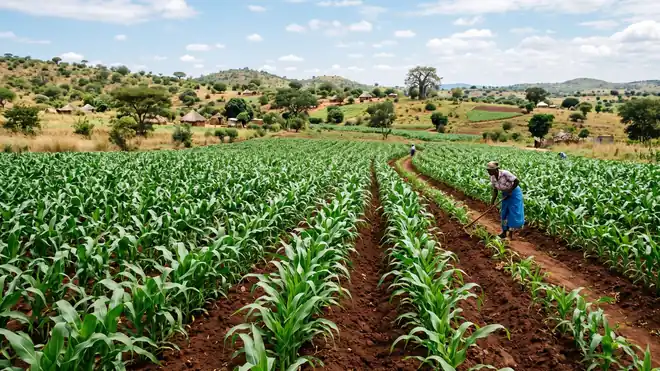
Potatoes pay well in Zimbabwe — and they demand a lot back. This is a crop for growers with irrigation, capital for certified seed, and the discipline to ridge, water and scout on schedule. Skip any one of those, especially the seed, and you’ll spend the season fighting blight and greening for a mediocre lift. Here’s the full picture, honestly, with every number sourced.
New to input-heavy crops? Before you commit land and cash to potatoes, work out your gross margin first — this is not a crop to grow on hope.
Potato planting windows at a glance
| Stage | Target / spec | Source |
|---|---|---|
| Best soils | Loamy, high organic matter, pH 5.0–5.5 | Agritex |
| Deep-till depth | At least 600 mm for good tuber development | Agritex |
| Summer (rain-fed) crop | Planted November | Agritex |
| First winter (irrigated) crop | Planted February–April | Agritex |
| Second winter crop | Planted late July–early August, post-frost | Agritex; CFU |
| Planting depth / spacing | 70–100 mm deep (irrigated); 900 x 300 mm | Agritex |
| Re-ridge by | Plant height of 25 cm | Agritex |
| Harvest | When 95% of leaves have died off | Agritex |
| National average yield | ~17 t/ha (2009–2013), 4th in southern Africa | Svubure et al. |
| Well-managed yield | Summer 17–20 t/ha; winter 24–27 t/ha; up to 40 t/ha | Agritex |
Where, when — and who this crop actually suits
Potatoes can grow all year on the middleveld and highveld, but frost, wet months and irrigation scheduling narrow it to three windows: rain-fed summer (November), first irrigated winter (February–April), and second winter (late July–early August), once frost risk has passed (Agritex) — frost-prone Matabeleland, Midlands and parts of Mashonaland specifically wait for that second window (CFU). Rain-fed summer is cheapest, because rain waters the crop for free, but it’s also riskiest: late blight thrives in wet, humid conditions, and complete chemical control during the rains is genuinely hard (Agritex). The winter crops need supplementary irrigation, but flood irrigation keeps blight pressure well below overhead systems (Agritex).
Zimbabwe’s national average yield sits around 17 t/ha (2009–2013), fourth in southern Africa (Svubure et al.) — but that hides a sharp split. Large-scale and A2 resettlement growers run mechanised operations averaging 11 ha and 8 ha under potato; communal and A1 growers average only 1.1 ha and 0.4 ha, with significantly lower fertiliser and crop-protection input (Svubure et al.). This is a crop that rewards growers who already have reliable irrigation and working capital for certified seed and disease management, and punishes growers who try to run it like a low-input crop — work out your gross margin on realistic input costs before you commit a hectare.
Seed is the biggest cost — and the binding constraint
More than soil, more than water, the seed you plant decides your season. Zimbabwe grades seed potato: Grade AA needs 99.5% varietal purity, under 0.25% leaf roll/severe mosaic virus, and no bacterial wilt at any growth stage; Grade A allows up to 1% virus tolerance; Grade XX is Grade A with limited mechanical damage (Agritex). Grade AA is only available June–July each year; Grade A year-round (Agritex).
Why it matters: certified seed guarantees freedom from bacterial wilt and caps virus levels — control of both starts with clean seed, plus destroying cull piles and volunteer plants after every crop (Agritex; AgriUniverse). Retained or informal seed carries no such guarantee, and because potatoes clone themselves from the tuber, any disease in the seed passes straight into the new crop. A national-level analysis flagged exactly this: seed shortages and depressed seed-breeding activity as a core constraint on Zimbabwean potato yield (Svubure et al.). Select firm, disease-free tubers with sprouts 5–15 mm long for the most vigorous plants, and discard anything under 25 mm (Agritex).
Soil prep for a genuine heavy feeder
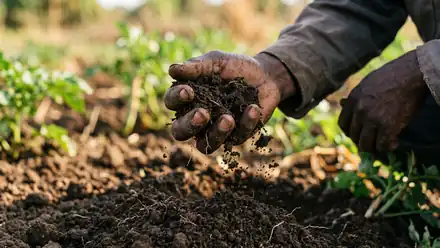
Potatoes want loamy soil, good organic matter, pH 5.0–5.5, worked to a fine tilth at least 600 mm deep (Agritex) — more acidic than most vegetables want, which is why lime is generally applied the season before rather than onto the potato bed itself.
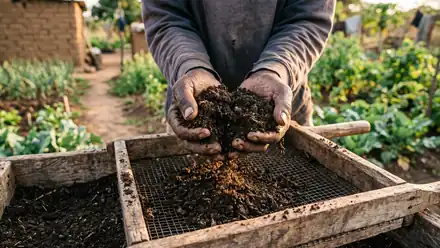
Working PCAT BLOCK C Organic Compost into that land ahead of planting builds the loose, deep, organic-matter-rich structure a heavy tuber crop needs — it’s the soil-health foundation, not a mineral swap. On the conventional side, Zimbabwean blenders sell a dedicated Potato Blend 10:19:25 precisely because potatoes need a phosphorus- and potassium-heavy, lower-nitrogen basal dressing (ZFC); Agritex’s own fertiliser table backs the same pattern, recommending far more phosphate than nitrogen at every fertility level (Agritex). See how much compost per crop in Zimbabwe for cited ranges, and message us with your crop and land size for a tailored rate — start with read your soil before you spend if you haven’t tested recently.
Depth, spacing and ridging — why it matters
Plant 70–100 mm deep under irrigation (up to 150 mm dryland), at 900 mm between rows and 300 mm in-row (Agritex). Then ridge, and don’t skip it: earthing up protects tubers from greening, tuber moth and late blight all at once, so plan it as part of weed control rather than a separate job, complete by 25 cm plant height (Agritex). Keep ridges wide and flat-topped — high, steep ridges erode and dry out faster — and avoid excessive cultivation between rounds, since potatoes are shallow-rooted (max ~600 mm) and deep hoeing damages roots (Agritex).
Tubers exposed to light through a thin ridge turn green with bitter, toxic solanine — buyers reject green potatoes outright, so this is a straight financial loss, not just cosmetics.
Water: steady after emergence, never excessive
Irrigate to field capacity at planting, hold off during emergence, then water regularly once flower buds appear through to maturity (Agritex). Guide rates: light soils ~25–30 mm every 3–4 days hot (5–7 cold); heavy soils ~30–35 mm every 4–5 days hot (8–9 cold) (Agritex). Excessive watering leaches nutrients and reduces keeping quality (Agritex) — more water late in the season is not automatically better. See drip irrigation on a budget and mulching to beat dry spells for stretching every millimetre.
Blight: the biggest disease, managed organic-first
Late blight (Phytophthora infestans) — brown lesions with pale-green borders that coalesce into black, water-soaked patches, capable of destroying all foliage within five days; on tubers it shows as rosy-red margin necrosis. Proliferates fastest at 17–21°C day / 10–16°C night, needing 7–10 hours of leaf wetness to sporulate heavily (Agritex; AgriUniverse). Early blight (Alternaria solani) — dark, concentric target spots, favoured by 20–30°C, high humidity and alternating wet/dry conditions; most late-blight fungicides also control it (Agritex; AgriUniverse). Both spread by wind, rain and irrigation splash, and both survive in soil and crop debris between seasons (AgriUniverse).
Organic-first defence, in order: certified disease-free seed; good tuber coverage via ridging; flood over overhead irrigation where possible; strict rotation and sanitation (destroy cull piles and volunteers); keep nitrogen in check, since excess nitrogen predisposes the crop to disease; and scout constantly (Agritex; AgriUniverse).
We won’t pretend fungicide has no place: fungicidal sprays are important on susceptible varieties, and may be needed even on tolerant ones during peak blight months of February–March (Agritex). Organic-first measures reduce but don’t eliminate that need, especially in the rain-fed summer window. Bacterial wilt (Pseudomonas solanacearum) is the other major threat — sudden wilting, brown vascular discolouration, dirty-white bacterial ooze from cuts, with no cure once present; control is entirely preventive through certified seed and disease-free land (Agritex).
Pests: tuber moth and cutworm lead the list
Potato tuber moth larvae tunnel leaves then stems and tubers; bury tubers under ~250 mm of soil via ridging, and clean fields of tubers and host weeds (Nicandra/Apple of Peru) after harvest (Agritex). Cutworms chew stems at ground level at night — check seedlings soon after planting. Aphids spread virus diseases rather than causing direct damage. Root-knot nematodes are the most common and damaging type, leaving watery blisters that collapse into crinkly scar tissue on lifted tubers; resistant grass-ley rotation is the main cultural control (Agritex).
Harvest, curing and storage
Harvest at 95% leaf die-off; the highest yields come from lifting 12–15 days after that point in cool, overcast weather (Agritex). In hot, dry conditions, move tubers to shelter immediately — sun exposure straight after lifting hurts keeping quality fast, and only wash tubers that are genuinely muddy (Agritex).
Store ware potatoes cold and dark — light causes greening and solanine just as it does in the field. At 3–5°C, sprouting is delayed 8–12 months, the single biggest lever on shelf life (Agritex). Seed tubers store best in ventilated wooden “chitin” trays; grade before storing, and dress clean tubers with an approved insecticide in a treated room (Agritex). Once graded, weigh up storing versus selling fresh with pricing your produce.
Frequently asked questions
Can I use my own saved potatoes as seed next season? You can, but you’re taking on real risk. Certified seed guarantees freedom from bacterial wilt and caps virus levels (Agritex); retained seed carries no such guarantee, and any disease in a cloned tuber passes straight into the new crop. Seed shortages and weak breeding capacity are a documented national constraint (Svubure et al.) — exactly why informal seed, and recurring disease, are so common.
What soil pH do potatoes actually want? 5.0–5.5 — more acidic than most vegetables. Hold the lime for the season before, not this crop (Agritex). Test first: read your soil before you spend.
Is compost enough on its own for a crop this hungry? No, and we won’t tell you otherwise. Potatoes need a phosphorus- and potassium-rich basal dressing, which is why a dedicated Potato Blend exists commercially (ZFC). Compost is the soil-health foundation underneath that dressing, not a replacement for it. Message us with your crop and land size for a tailored PCAT BLOCK C rate.
Do I need to spray fungicide, or can I go fully organic? Organic-first practice — certified seed, ridging, flood irrigation, rotation, sanitation — meaningfully reduces blight pressure and is the right starting point (Agritex). But commercial guidance is honest that fungicide may still be needed on resistant varieties during peak blight months, especially in the rain-fed summer window (Agritex).
Are potatoes actually profitable for a smallholder? They can be, but the data shows a real gap: large-scale and A2 growers average 8–11 ha under potato with higher mechanisation and input use, while communal and A1 growers average under 1.2 ha (Svubure et al.) — this crop rewards scale and capital. Run your gross margin on real seed and irrigation costs before committing land.
Do this now
- Choose your planting window deliberately — rain-fed November carries the highest blight risk; the irrigated winter windows cost more but carry lower disease pressure.
- Buy certified seed, not retained tubers, and check the grading before you pay.
- Deep-till to 600 mm and build organic matter — target pH 5.0–5.5, and hold the lime for next season.
- Plant at 900 x 300 mm and ridge properly — re-ridge by 25 cm, wide and flat-topped.
- Water to field capacity at planting, then hold off until flowering — never let excess water leach nutrients or spoil storage quality.
- Scout for blight constantly and keep nitrogen in check — organic-first, honest about when fungicide is still needed.
- Cure and store cold, dark and ventilated.
PCAT BLOCK C — the locally-made, field-proven compost that rebuilds Zimbabwe’s tired, acidic soils.
Related: know your gross margin · how much compost per crop in Zimbabwe · sweet potatoes need feeding too
- Agritex Zimbabwe Farm Management Handbook — Potato Production (soils, seed grading, fertiliser, ridging, harvest, storage, pests & diseases)
- Svubure, Struik, Haverkort & Steyn — Comparative analysis of Irish potato production in Zimbabwe's farming sectors (University of Pretoria repository)
- AgriUniverse Zimbabwe — Potato Diseases: a closer look at Late Blight
- AgriUniverse Zimbabwe — Potato Diseases: a closer look at Early Blight
- ZFC — Customer-specific blends (Potato Blend 10:19:25)
- Commercial Farmers' Union of Zimbabwe — Winter potato farming begins
Join our free mailing list and we'll send the full 2026/27 calendar plus weekly seasonal tips.