Best tomato varieties for Zimbabwe: open-field vs greenhouse
Best tomato varieties for Zimbabwe explained — determinate vs indeterminate, fresh-market vs processing, and how to pick between open-field and tunnel growing.
“Best variety” is the wrong first question. The right first question is: what growing system, and what market, are you actually growing for? Answer that, and the variety choice becomes simple. This guide breaks down the real trade-offs — determinate vs indeterminate, fresh-market vs processing, open field vs tunnel — using seed-company agronomy notes. A disclosure up front: seed companies naturally favour their own hybrids, so treat named cultivars below as examples of a type, not a definitive ranking, and always confirm current availability and price with your local agro-dealer.
Not sure which system suits your plot? Read the full lifecycle guide first: growing tomatoes in Zimbabwe.
At a glance
| Type | Growth habit | Best suited to | Typical use |
|---|---|---|---|
| Determinate (blocky) | Stops growing at a set height, sets fruit over a shorter window | Open field, shorter season | Fresh market, uniform harvest |
| Semi-determinate | Middle ground — moderate height, extended but not indefinite fruiting | Open field or lighter protection | Fresh market |
| Indeterminate | Keeps growing and fruiting for months if disease is controlled | Tunnels / greenhouses | Long-shelf-life fresh market, extended supply |
This determinate / semi-determinate / indeterminate split is exactly how Seed Co Zimbabwe categorises its own tomato range for the local market (Seed Co) — it’s the first fork in the decision tree, before you even get to a variety name.
Determinate vs indeterminate — what it actually means for you
Determinate (“blocky”) varieties grow to a fixed height, flower and fruit over a defined window, and then tail off. That makes them well suited to open-field growing with a defined harvest season — you know roughly when the crop starts and stops, which helps with planning labour and market timing.
Indeterminate varieties keep growing and setting new trusses indefinitely, provided pests and disease are kept under control and nutrient supply keeps up (Seed Co). Seed Co’s own tunnel guide is explicit that indeterminate types are recommended for tunnels and can last up to 8 months under protection, while the traditional bush/determinate type — the one grown outdoors — is not recommended for tunnel growing (Seed Co). If you’ve built or are considering a tunnel, that single fact should drive your variety choice.
Semi-determinate varieties sit between the two — a middle-ground habit Seed Co also lists as a distinct category for the Zimbabwean market (Seed Co) — useful where you want more fruiting weeks than a pure determinate type without committing to full tunnel-style management.
Named varieties — read the source, not just the name
Seed-company literature for the region names a small number of indeterminate hybrids for tunnel use, including Thomas and Birsen, described as good-yielding options for growers targeting long shelf life (Seed Co). The same guide is candid about why shelf life matters commercially: most of the population has no fridge, so a tomato that holds up in transit loses less value between farm and buyer (Seed Co).
Seller-bias flag: this recommendation comes from a seed company’s own production guide, and the varieties named will naturally be ones that company sells. Treat it as a starting shortlist, not gospel — cross-check current stock, price and disease-resistance packages with your agro-dealer, and ask what determinate and semi-determinate hybrids they’re currently carrying if open-field is your system.
Fresh-market vs processing
Zimbabwean production guides frame the crop primarily around the fresh market — eaten raw, cooked, or processed into sauce (AgriUniverse) — and the variety traits above (shelf life, truss size, blocky shape) are fresh-market considerations: how the fruit looks, holds and travels to a hawker, supermarket or Mbare Musika stall. Contracting to a processor is different — your buyer will typically specify the variety and seed source directly rather than leaving it to you, so confirm the spec with them before committing a season to it.
Heat and disease tolerance — what the guides actually say
Zimbabwean tomato agronomy notes are consistent on climate sensitivity rather than naming heat-tolerant cultivars specifically: tomatoes are highly susceptible to frost, and long periods of humidity and rainfall reduce yields significantly, as does waterlogging (AgriUniverse). That’s a climate-and-timing problem as much as a variety problem — it’s answered as much by when and how you plant (season, drainage, airflow, spacing) as by which hybrid you choose. For disease specifically — blight, wilt, mites, whitefly — see our dedicated organic control guide: tomato pests & diseases in Zimbabwe.
Under tunnels, temperature control cuts the other way too: mechanical pollination (tapping the overhead wire, since bee activity is restricted under cover) doesn’t work reliably below 20°C, so early-morning pollination attempts in a cool tunnel can fail (Seed Co) — one more reason tunnel growing needs different management discipline than open-field, whatever variety you plant.
Open field vs tunnel — the real decision
| Factor | Open field | Tunnel / greenhouse |
|---|---|---|
| Variety fit | Determinate / semi-determinate | Indeterminate (Seed Co) |
| Spacing | 1.0–1.5 m rows x 0.5 m in-row (AgriUniverse) | 40 cm in-row, 60 cm between double rows (Seed Co) |
| Cropping window | Defined season | Up to ~8 months per planting (Seed Co) |
| Management intensity | Lower — rain-fed possible with irrigation top-up | Higher — pollination, EC/fertigation monitoring, leaf removal on a strict schedule (Seed Co) |
| Capital cost | Lower | Higher (structure, growing media, irrigation) |
A tunnel buys you a longer season, tighter disease control, and (with the right variety) months more harvest from the same footprint — but it demands far more hands-on management, including electrical-conductivity monitoring of your fertigation solution and disciplined leaf removal every fortnight to keep airflow and prevent Botrytis (Seed Co). Open field is simpler to start with and lower-capital, but you’re more exposed to rainfall, humidity and a shorter window. We cover the full build-and-manage decision in greenhouse and tunnel farming in Zimbabwe.
Whichever system you choose, the soil comes first
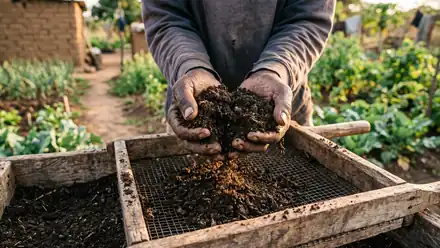
Variety and structure decide your ceiling; soil decides whether you get anywhere near it. An indeterminate hybrid in a tunnel with tired, acidic, low-organic-matter soil underneath it will still underperform. Build the soil first with PCAT BLOCK C Organic Compost — it’s the same rebuilding step whether you’re growing a determinate variety in the open field or an indeterminate one under cover — and work out roughly how much you need with how much compost per crop in Zimbabwe.
Do this now
- Decide your system first — open field or tunnel — before you pick a variety name.
- Match growth habit to system: determinate/semi-determinate outdoors, indeterminate under cover (Seed Co).
- Confirm your market — fresh-market shelf life vs a processor’s contracted spec — before locking in seed.
- Cross-check any named variety with your agro-dealer for current stock, price and local disease pressure.
- Build the soil regardless of variety — compost is the foundation under every hybrid.
PCAT BLOCK C — the locally-made, field-proven compost that rebuilds Zimbabwe’s tired, acidic soils.
Related: growing tomatoes in Zimbabwe · greenhouse and tunnel farming in Zimbabwe · tomato pests & diseases the organic way
Join our free mailing list and we'll send the full 2026/27 calendar plus weekly seasonal tips.