Aphids & diamondback moth: organic control for your greens
Diamondback moth organic control for Zimbabwean growers — how to identify aphids and diamondback moth on covo, rape and cabbage, scout properly, and hold both pests back without burning through chemical sprays.

If your covo, rape or cabbage bed has gone from clean to holed in a week, you’re almost certainly hosting one of two pests: aphids or diamondback moth. Both can shred a planting fast, both build resistance to careless spraying, and both are beatable without reaching for a chemical every time you see a hole in a leaf. Here’s how to tell them apart, scout properly, and hold them back the organic way.
Growing covo, rape or spinach right now? Read growing leafy greens in Zimbabwe alongside this guide — feeding and pest control are two halves of the same job.
Know your enemy: aphid or diamondback moth?
These two pests do almost all the damage on brassica-family greens, but they attack differently and need different responses.
| Feature | Aphids | Diamondback moth (DBM) |
|---|---|---|
| What you see | Tiny (1–3 mm), soft-bodied, roundish insects — yellow, green, brown or purple — clustered on leaf undersides and growing tips (CABI PlantwisePlus) | Small, pale green caterpillars with no distinct markings; adult moths have three diamond shapes on their wings (CABI PlantwisePlus) |
| Damage sign | Curling or distorted leaves, sticky “honeydew” that turns into black sooty mould, virus spread | See-through scratches or “windows” on the underside of young leaves; on seedlings, feeding on the growing point can stunt the whole plant (CABI PlantwisePlus) |
| Feeding style | Sucks sap from leaves and stems | Chews leaf tissue, mines young leaves as first instars |
| Worst conditions | Warm weather, dense unthinned plantings, virus-carrying colonies build fast | Numbers increase rapidly in dry weather; heavy rain and overhead irrigation wash young caterpillars off the plant (CABI PlantwisePlus) |
| Scientific name | Brevicoryne brassicae (cabbage aphid) (CABI PlantwisePlus) | Plutella xylostella (CABI PlantwisePlus) |
Don’t confuse aphids with thrips, which also turn up on onions and are similarly small — thrips are thinner and longer, aphids are roundish (CABI PlantwisePlus).
Scout weekly — you can’t manage what you don’t see
Both pests are far easier to hold back at low numbers than after they’ve built a population. Make scouting a fixed weekly habit, not a reaction to visible damage:
- Walk the bed and turn leaves over. Aphids and DBM eggs both sit on the leaf underside — you’ll miss both if you only glance at the tops of leaves.
- Check growing points and young leaves first. This is where DBM does its most damaging feeding on seedlings, and where new aphid colonies establish.
- Look for the tell-tale signs, not just the insects: curling leaves and sooty black mould for aphids; translucent “windows” and fine scratches for DBM.
- Use yellow sticky traps to monitor DBM adults and catch a building population before caterpillars are doing visible damage (CABI PlantwisePlus).
- Act on small colonies, not waiting for a visible infestation — a few aphids on a handful of plants is manageable by hand; a bed-wide bloom is a much bigger job.
A simple scouting calendar: nursery and first two weeks after transplant — check daily, growing points are most vulnerable. From week three to first harvest — check twice weekly. Once you’re cutting leaves regularly — check weekly, and every time you’re in the bed anyway.
Cultural controls: make the bed less attractive before you spray anything
The cheapest pest control happens before you ever pick up a sprayer.
- Intercrop with onion or garlic against aphids. Onions produce a chemical that many aphid species avoid, and bordering or intercropping brassica beds with onion rows is a documented smallholder practice for aphid control (CABI PlantwisePlus). A workable layout: onion border rows around the bed, with onion rows at roughly 15 cm inter-row spacing and onions spaced about 10 cm apart within the row, planted about two weeks before you transplant your cabbage or greens into the same bed (CABI PlantwisePlus).
- Interplant with tomato or pepper against diamondback moth. DBM can be repelled by growing tomato or pepper among your brassica crop rather than a solid monoculture block (CABI PlantwisePlus).
- Rotate brassica-family crops out of the same bed each season. Continuous rape, covo or cabbage in the same soil lets both pests build up a resident population that just waits for the next planting.
- Sanitation matters. Remove and destroy badly infested leaves and old crop residue rather than leaving them in or near the bed — both pests can carry over on plant debris.
- Stagger plantings carefully. For fast-turnover greens like rape and covo, staggered strips give you continuous harvest — but be aware that a field with plants of many different ages side by side can let DBM move steadily from older to younger plants, so keep some distance between very different planting dates where you can.
Protect your natural enemies
Zimbabwe’s fields already carry a quiet workforce that eats both pests for free: parasitic wasps and other parasitoids, ground beetles, true bugs, syrphid fly larvae and spiders all prey on diamondback moth eggs and caterpillars, and many of the same predators take aphids too (CABI PlantwisePlus).
- Avoid spraying when natural enemies are already keeping numbers down. A blanket spray on a bed that’s mostly under control kills the predators along with the pests — and often makes the next generation worse, because the pests recover faster than their enemies do.
- Grow flowering plants nearby to feed adult syrphid flies and other beneficial insects, giving them a reason to stay in and around your beds (CABI PlantwisePlus).
Physical and soft controls, before you reach for a chemical
- Yellow sticky traps or pheromone traps catch DBM adults early, giving you warning before caterpillars are doing damage (CABI PlantwisePlus).
- Overhead irrigation and planting in the rainy season genuinely help against DBM — heavy water knocks young caterpillars off the plant, which is one reason DBM outbreaks tend to be worse in dry spells (CABI PlantwisePlus).
- Hand-crush aphid colonies on individual leaves while you’re scouting — genuinely effective on small plots before numbers explode.
- Biological pesticides such as Bacillus thuringiensis (Bt) and Beauveria bassiana are recommended non-chemical options against diamondback moth where they are available to you (CABI PlantwisePlus). Confirm current registration and stockist availability locally before you plan around any specific product — biopesticide registration and distribution vary and change over time.
If you do spray: respect the resistance warning on DBM
Diamondback moth has a long, well-documented history of shrugging off insecticides — it was already developing resistance to DDT in the 1950s, and it has gone on to build resistance to nearly every new chemical class introduced since, especially where the same product is used repeatedly on back-to-back generations (IRAC; UC IPM). DBM can complete a generation in under three weeks in warm conditions, so a chemical that “worked last time” can fail within a season if you lean on it too hard.
If a spray is genuinely necessary:
- Never repeat the same product, or the same mode of action, on consecutive DBM generations. Rotating between different modes of action is the single most important thing you can do to keep any product working (IRAC).
- Spray only when scouting shows you need to, not on a routine calendar — unnecessary spraying is exactly what drives resistance and kills the natural enemies doing free work for you.
- Respect the pre-harvest interval on the label. On a crop you’re picking every few days for the market, any chemical spray costs you days you can’t afford to lose — lean on scouting, natural enemies and soft options first, precisely because they don’t come with that waiting period.
The healthy-plant angle: well-fed crops shrug off more pressure
A vigorous, well-nourished plant tolerates aphid and DBM pressure far better than one struggling on tired, acidic soil. Plants under nutrient stress grow slowly, produce thinner leaf tissue, and simply have less capacity to outgrow feeding damage — the same principle that helps maize shrug off fall armyworm applies just as directly to covo, rape and cabbage under aphid and DBM pressure.
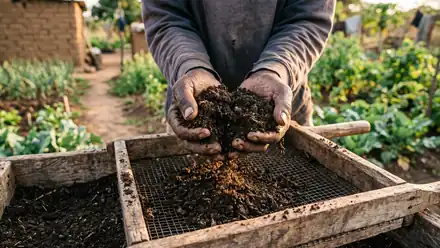
Building organic matter into the bed with PCAT BLOCK C Organic Compost before you plant gives your greens the standing fertility to grow fast and stay ahead of pest damage — one more reason healthy soil is your first line of defence, not an afterthought once pests show up. If your beds haven’t been tested, start with read your soil before you spend so you know exactly what you’re working with before you plan your compost and fertiliser programme.
Do this now
- Scout weekly, turning leaves over — check growing points daily for the first two weeks after transplant, when both pests do the most damage.
- Border or intercrop with onion or garlic against aphids, and interplant tomato or pepper against diamondback moth where your layout allows it.
- Spare your natural enemies — don’t spray a bed that’s mostly under control, and grow flowering plants nearby to keep predators around.
- Use yellow sticky traps to catch a building DBM population before you see caterpillar damage.
- Rotate brassica beds and clean up crop residue so neither pest carries over season to season.
- If you spray, rotate modes of action and never repeat the same product on back-to-back DBM generations.
- Feed the soil before the season starts — a strong, well-fed plant tolerates far more pest pressure than a stressed one.
PCAT BLOCK C — the locally-made, field-proven compost that rebuilds Zimbabwe’s tired, acidic soils.
Related: growing leafy greens in Zimbabwe · cabbage farming in Zimbabwe · beating fall armyworm organically · read your soil before you spend
- CABI PlantwisePlus — Diamondback Moth on Brassica (factsheet: ID, lifecycle, non-chemical and chemical control)
- CABI PlantwisePlus — Intercrop cabbage with onion against aphids (factsheet: ID, mechanism, spacing)
- Seed Co Vegetables Grower's Guide
- Seed Co Cabbage Production Guide
- IRAC — Insecticide Resistance Management for Diamondback Moth in Cole Crops
- UC IPM — Diamondback Moth (Cole Crops)
Join our free mailing list and we'll send the full 2026/27 calendar plus weekly seasonal tips.