Zimbabwe's horticulture export boom: blueberries, peas and beyond
Zimbabwe horticulture exports tripled to US$181.7m in 2025. Here's the crops driving the surge, what the HDC and ZimTrade are targeting, and how smallholders can realistically plug in.
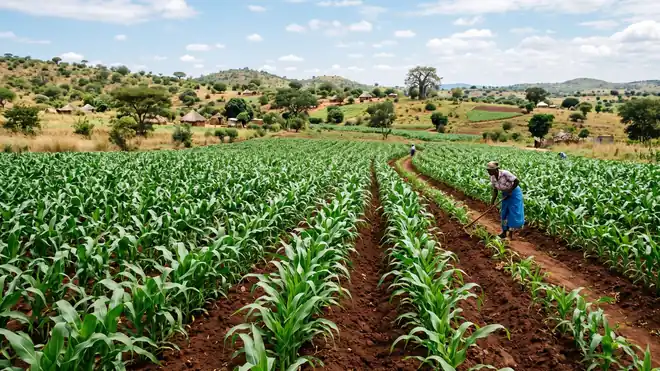
Zimbabwe’s horticultural export sector has had a genuinely remarkable twelve months, and for once the numbers are hard. Export earnings more than tripled to US$181.7 million in 2025, up from US$59.8 million in 2024 — a rise of over 200% year-on-year, according to ZimTrade data reported by Newsday (Newsday). International buyers from the EU, the UK, Germany, and Kenya have expressed interest in establishing long-term partnerships with Zimbabwean producers, according to the same report.
That’s the headline. Now here is the honest picture beneath it: the crops driving this, the structural challenges that persist, how outgrower schemes work in practice, and what the opportunity actually looks like for a Zimbabwean smallholder in mid-2026.
Reading about chillies specifically? See the companion piece Zimbabwe’s chilli export boom: what it means for smallholders for the full chilli and paprika story.
What’s driving the surge
| Crop / product | What’s happening |
|---|---|
| Blueberries | Primary driver of the 2025 export surge — mainly large commercial farms supplying EU markets (Newsday) |
| Chillies | A growing smallholder story — Nyanga shipped 440 t to the US in 2024; a 300,000-farmer outgrower scheme announced for China (Newsday) |
| Peas / mangetout | Established export crop from Eastern Highlands (Nyanga, Mutare region); valued for year-round supply to EU retail |
| Macadamia | Growing commercial tree-crop sector; long establishment timelines but high per-kg values |
| Citrus | Long-standing Zimbabwean export; recovery underway after years of infrastructure and tree-stock decline |
| Floriculture | A smaller but established export niche — cut flowers from high-altitude regions |
The 2025 surge was led by blueberries into EU markets — primarily a large commercial-farm story rather than a smallholder one at this stage (Newsday). But blueberry export success has opened logistics routes, built buyer relationships, and created the infrastructure groundwork that other crops — including those smallholders can grow — are beginning to access.
The HDC and ZimTrade growth ambitions — what’s been said
Zimbabwe’s Horticultural Development Council (HDC) and ZimTrade have both set growth targets and outlined support programmes. It is worth being precise about what is claimed versus what is confirmed results:
ZimTrade has been running Export Awareness Seminars for smallholder clusters — including sessions in Rusape for chilli growers — connecting producers with international buyers and market requirements (ZimbabweNow). The organisation has cited strong Chinese buyer interest in Zimbabwean chilli volumes specifically.
The HDC has, according to the Financial Gazette, been vocal about the need to establish dedicated horticulture Special Economic Zones to provide reliable cold-chain infrastructure, stable power, and consolidated pack-houses for export produce (Financial Gazette). These are proposals, not completed infrastructure — but they point to where the sector’s leadership sees the structural gaps.
Both organisations have also flagged, frankly, the headwinds. As of July 2026 — even in what is otherwise a positive export season — the HDC has noted that escalating freight prices, expensive financing, and rising production costs are actively eroding sector gains (Financial Gazette). A year earlier, cost pressures were already pushing smaller horticulture farmers out of the market entirely (Financial Gazette). The boom is real; so is the squeeze.
The crops — what a smallholder can actually grow
Blueberries: high-value, high-barrier
Blueberries are the headline crop but they are not, at this stage, a realistic smallholder entry point without substantial capital or a large-scale outgrower sponsor. The crop needs:
- Specialised acidic soil management (pH 4.5–5.5) and significant soil amendment investment
- A 3–4 year establishment period before meaningful production
- Cold-chain infrastructure at harvest — supermarket-grade EU buyers require pre-cooling and cold transport that most smallholder setups cannot provide independently
The blueberry story is inspiring evidence that Zimbabwe can win top-tier export business on quality. It’s not a template you can replicate on a 0.5 ha plot in a single season.
Peas and mangetout: more accessible, but specification-intensive
Mangetout and fine-bean peas from the Eastern Highlands have a much longer history as a smallholder-accessible export crop. The cool high-altitude climate of the Nyanga–Mutare corridor produces consistently high-quality pods that EU buyers have sourced for decades. Outgrower schemes in this area typically offer:
- Seed (selected varieties that meet buyer specifications)
- Technical support for growing to grade
- Guaranteed offtake, usually via a centralised pack-house
The barrier here isn’t capital so much as consistency: EU retail buyers want uniformity across consignments, which means every farmer in a scheme needs to be hitting the same size and colour standards. Soil health is a direct driver of that consistency — even, well-fed plants produce even pods. This is the through-line we return to at the end of this article.
Chillies: the best current smallholder entry point
For the full picture on chilli and paprika, read Zimbabwe’s chilli export boom: what it means for smallholders. The short version:
- At the Nyakomba Irrigation Scheme in Nyanga, farmers on roughly 0.2 ha plots exported 440 tonnes of chilli to the US in 2024, earning over US$270,000 for the group, according to a Herald report cited by Makumbirofa Farms (Makumbirofa Farms, citing The Herald).
- Chilli contributes around 39% of household farm income for smallholder growers in this cluster (ZimbabweNow).
- Agro-processing firm Stagri-Brands, alongside ARDA and ZimTrade, has announced a scheme targeting 300,000 farmers and 50,000 tonnes annually to China — pending finalisation of the bilateral trade protocol (Newsday). These are announced targets, not completed enrolments.
Macadamia and citrus: long-term tree-crop plays
Macadamia has become an increasingly discussed export crop, particularly in suitable climatic zones of Manicaland and parts of Mashonaland East. The crop commands high per-kilogram export prices, has a growing international market, and suits Zimbabwe’s highland soils. The constraint is time: meaningful nut production requires 5–7 years from planting. This is a crop for a grower with land to commit on a long horizon, not a quick-turnaround smallholder strategy.
Citrus — mainly navels, Valencia, and grapefruit from the Mazowe and Lowveld regions — has long export history and steady EU/regional demand. The challenge for Zimbabwe’s citrus sector has been rebuilding after the loss of commercial infrastructure through the 2000s land reform period. Recovery is underway but requires significant replanting and re-establishment of pack-house capacity.
How smallholders plug in — and where the honest barriers are
Outgrower and contract farming schemes are the most realistic pathway for a smallholder to access export markets. Here is how these arrangements typically work in Zimbabwe’s horticulture sector, and where the complications arise:
What schemes typically offer:
- Seed and sometimes other inputs, often provided upfront and deducted from payment at delivery
- Access to a buyer and, in some cases, a centralised pack-house or cold store
- Agronomic support — in practice, the quality and frequency of this varies significantly by scheme
- A price or price formula agreed before planting (in the better-run schemes)
The honest barriers:
Quality and grading. Export buyers grade on size, colour, defect levels, and sometimes residue limits. A crop that looks saleable to you can be downgraded or rejected at the pack-house. This is not a bureaucratic technicality — a rejected load is money you spent growing a crop you cannot sell at the contracted price. See export-quality peppers start with the soil for what actually drives quality rejections at the root level.
Contract risk. Verbal assurances from a scheme recruiter are not a contract. Get price, grading criteria, payment timeline, and who bears the risk of a rejected load in writing before you plant. Zimbabwe’s own agricultural history has hard lessons on this — see the chilli export boom companion article for the 2010 paprika cautionary case.
Capital and cash flow. Even in schemes where inputs are supplied, growers typically carry costs through the growing season and receive payment weeks to months after delivery. If input costs rise mid-season or payment is delayed, you carry the difference. Work out your break-even carefully before committing land — use know your gross margin and run the numbers against what that plot currently earns you.
Logistics and cold chain. For fresh produce, the gap between “grown to grade” and “arrived at the buyer’s door in exportable condition” can be significant. Where does your crop go after harvest? Who provides pre-cooling? Who manages the freight logistics? These questions matter — and the HDC’s own commentary in 2026 has acknowledged that this infrastructure gap remains the sector’s most persistent structural constraint (Financial Gazette).
No invented rates. Compost and organic inputs are a soil-health investment — they are not a substitute for export certification, and we make no claims that using compost qualifies a crop for any particular export market. What compost does is build the even, healthy, biologically active soil that produces the consistent, uniform crops that grade well. That’s the honest through-line.
Why it all starts with the soil
Every export crop discussed above — blueberries, peas, chillies, citrus, macadamia — shares one requirement: a plant that is even, well-fed, and consistent through the season. That’s the plant that produces the fruit, pod, or root the buyer’s grader approves.
The factors that cause export rejections — undersized fruit, uneven colour, cracked or split produce, soft tissue, disease damage — all trace back, in whole or in part, to uneven nutrition, moisture stress, or soil-borne disease pressure. And all of those are soil-health issues at root.
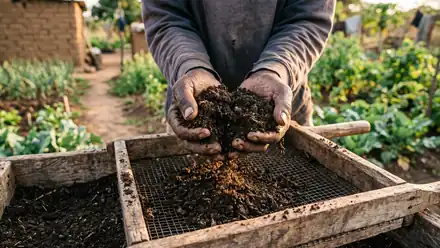
Zimbabwe’s soils are under pressure: decades of continuous cropping, tillage, and under-investment in organic matter have left many fields depleted, acidic, and structurally weak. Rebuilding that organic matter and tilth with PCAT BLOCK C Organic Compost is the foundation step — not a luxury, and not a marketing claim. Even fertility, improved moisture buffering, and a more biologically active soil are what produce the crop that survives grading. The wider case is made in full in export-quality peppers start with the soil.
Before you engage with any export scheme or outgrower recruiter, start with read your soil before you spend. Know what your soil needs. Build that soil. Then plant the crop.
Do this now
- Read the fine print on any outgrower offer — get grade specifications, price, and payment terms in writing before you commit a single seed.
- Run your gross margin first. Use know your gross margin to compare the export scheme’s contracted economics against what you currently earn from that land.
- Start on a trial plot. Follow the Nyakomba model — small area, prove the system, then scale.
- Build your soil before you pitch for a contract. Buyers want supply history and field consistency; start that soil-building now with PCAT BLOCK C Organic Compost.
- Keep records from day one. A documented crop history, input log, and yield record lets you negotiate from strength, demonstrate traceability, and prove your case if a dispute arises.
- Compare export against local pricing before signing anything — pricing your produce will help you benchmark what you’re giving up or gaining by going the contract route.
PCAT BLOCK C — the locally-made, field-proven organic compost that gives Zimbabwe’s export-minded growers the even, well-fed, soil-healthy crop that grades well and builds buyer trust.
Related: Zimbabwe’s chilli export boom: what it means for smallholders · export-quality peppers start with the soil · know your gross margin · read your soil before you spend · pricing your produce
- Newsday — Zim horticulture wins global market interest (ZimTrade data, March 2026)
- Newsday — 300K Zim farmers to benefit from chilli production (Stagri-Brands, ARDA, ZimTrade)
- Makumbirofa Farms — Zimbabwean farmers spice up the USA market with Nyanga chillies (citing The Herald)
- ZimbabweNow — Chilli farmers eye export markets, global growth (ZimTrade seminar)
- Financial Gazette — Horticulture sector faces cost headwinds (HDC, July 2026)
- Financial Gazette — Costs push out horticulture farmers (August 2025)
- Financial Gazette — 'Establish horticulture SEZs' (July 2025)
- FAO Zimbabwe country page
Join our free mailing list and we'll send the full 2026/27 calendar plus weekly seasonal tips.